
Rethinking AI Strategy in Commercial Analytics

Improzo Insights
Perspectives from practitioners in commercial analytics and AI

Executive Summary

Commercial analytics in pharma is shifting from static dashboards and retrospective analysis to actively shaping decisions in near real time. As generative and answer-driven systems surface recommendations directly inside workflows, analytics models built for dashboards and post-hoc analysis show their limits. Organizations seeing real impact are not experimenting with more AI tools, but redesigning how decisions are supported, governed, and executed. A decision-centric approach grounded in clarity of ownership, traceability, and operational adoption is becoming essential for scaling AI in commercial settings.

Rethinking AI Strategy in Commercial Analytics: A Decision-Centric View

Asking whether a pharma organization has an “AI strategy” is increasingly the wrong question. The more useful question is simpler and more operational: which commercial decisions do we want to improve, and why aren’t they working today?

In commercial analytics, AI discussions often gravitate toward tools, models, or platforms. But value is rarely created by technology alone. It comes from better decisions made faster, with clearer context, and with confidence in how they were formed. That distinction matters more as generative and answer-driven systems begin to influence decisions earlier in the commercial workflow.

From explaining outcomes to shaping decisions

Advanced analytics and machine learning have supported commercial teams for years — from targeting and segmentation to forecasting and incentive design. Historically, these systems were designed to explain outcomes. Teams reviewed dashboards, debated insights, and translated findings into action.

Answer-driven systems compress that flow. Recommendations now surface directly inside workflows such as call planning, account strategy, or territory optimization — sometimes before a dashboard is opened.

In one large biotech commercial team, early pilots surfaced recommendations directly in call planning. The models performed well, but adoption stalled when field leaders couldn’t explain why certain HCPs were prioritized over others during review discussions. The models were accurate, but accuracy alone was not enough to earn trust at the point of execution.

This creates opportunity, but it also exposes gaps. Systems built for exploration struggle when asked to support real-time commercial decisions. When recommendations appear closer to execution, teams expect clarity: how the recommendation was formed, what data was used, and what assumptions were applied. Without that visibility, confidence erodes quickly, regardless of the model’s performance.

“AI creates value in commercial analytics only when it improves how decisions are made — not when it simply generates more insight.”

A decision-centric foundation for commercial AI

A practical AI strategy in commercial analytics starts by anchoring on decisions, not use cases.

  1. Define the decision and its owner. Whether the decision involves call planning, targeting, or forecasting, clarity on ownership and success criteria is essential. AI should support decisions already embedded in the business, not create parallel processes.
  2. Prioritize use cases based on value and feasibility. Focus on decisions with clear commercial impact, sufficient data, and realistic adoption paths. Ambiguous outcomes and long time-to-value timelines often derail otherwise strong initiatives.
  3. Measure success operationally. Accuracy alone is not enough. Commercial leaders care about adoption, confidence, cycle-time reduction, and impact on execution. Metrics should reflect how decisions are made and acted upon.

Operating model, governance, and enablers

As AI moves closer to execution, organizational design matters as much as technology.

Successful commercial analytics efforts typically align three roles:

  • Consumers: Brand, sales, and commercial ops leaders who rely on recommendations
  • Translators: Individuals who connect business context with data and analytics
  • Producers: Teams responsible for building and maintaining AI capabilities

Governance plays a similar role. Effective governance is not about slowing innovation; it establishes accountability, clarity, and trust. In commercial settings, the ability to explain how a recommendation was formed often matters more than algorithmic sophistication. None of this works without the right enablers. Data quality, interoperable technology foundations, domain-savvy talent, and selective partnerships determine whether AI becomes embedded or remains experimental.

From experimentation to impact

AI delivers sustained value in commercial analytics only when it improves how decisions are made and executed. That requires discipline: monitoring outcomes, reinforcing adoption, and continually aligning AI initiatives with evolving commercial priorities.

A decision-centric approach reframes AI from a collection of tools into an operating capability. For commercial analytics leaders, that shift — more than any specific technology choice — is what separates experimentation from real impact.

From Decks to Engines: How Generative AI Is Reshaping Pharma Commercial Execution

Over the past decade, pharmaceutical organizations have invested heavily in modernizing their data infrastructure. Commercial ecosystems now include CRM platforms, omnichannel engagement systems, commercial data warehouses, and increasingly sophisticated analytics environments designed to support brand strategy, field execution, and market access planning. Despite these investments, the operational model through which many leadership decisions are made has evolved far less than the technology stack supporting them. In many commercial organizations, analytical turnaround for leadership updates still ranges from several days to multiple weeks.

Before major leadership moments—such as National Sales Meetings (NSMs), Quarterly Business Reviews (QBRs), or strategic brand updates—organizations typically request a familiar set of analyses: brand performance diagnostics, market share trends, field execution summaries, and competitive intelligence updates. Analytics teams and vendor partners assemble datasets, reconcile metrics, generate models, and ultimately produce presentation decks that summarize the latest performance signals.

The analytical rigor behind these deliverables is often strong. However, the process introduces a structural constraint: latency of insight. Markets evolve faster than reporting cycles. Access dynamics shift, competitor narratives change, and HCP behavior adapts continuously. When insight generation depends on manual analytical workflows, organizations often respond only after signals have already matured. Generative AI introduces the possibility of a fundamentally different operating model—one in which commercial organizations rely less on periodic reporting cycles and more on intelligence engines capable of answering operational questions in near real time. The question facing leadership teams is therefore increasingly straightforward: are organizations still producing decks to interpret the past, or are they building systems capable of continuously interpreting the present?

The Rise of Answer Engines in Pharma

Across industries, generative AI is changing how professionals interact with data.

Instead of navigating dashboards or requesting analyses from analytics teams, users increasingly ask direct questions:

  • What changed in prescribing trends this quarter?
  • Which territories are underperforming relative to opportunity?
  • Where are payer restrictions creating access friction?

Modern AI systems can synthesize answers across structured and unstructured datasets and generate contextual explanations aligned with these questions. Within pharmaceutical organizations, this capability enables the emergence of domain-specific answer engines—systems designed to continuously analyze commercial, medical, and engagement data and translate those signals into decision-ready intelligence.

Rather than waiting weeks for analyses to be produced, leadership teams can increasingly interact directly with their enterprise data ecosystem. The underlying signals already exist within CRM systems, prescription datasets, scientific intelligence sources, and payer data environments. What changes is the organization’s ability to interpret those signals dynamically and present them in a form that supports operational decisions.

The Pharma Intelligence Engine Framework

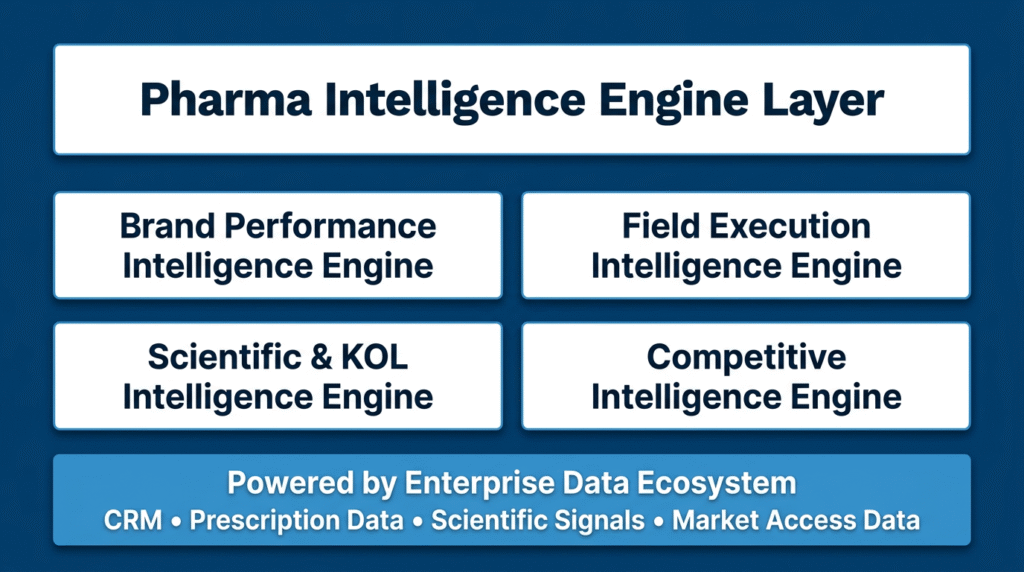
As generative AI adoption accelerates, several intelligence engines are likely to become foundational components of commercial and medical operations in pharma. A practical way to understand this transition is through four intelligence engines that together translate fragmented enterprise data into actionable insights.

Intelligence Engine Same Question Answered Primary Data Sources Operational Impact
Brand Performance Engine What is driving brand performance right now? Prescription data, payer coverage, patient journey signals Identifies performance drivers and emerging market shifts
Field Execution Engine Where should the field focus next? CRM engagement data, physician behavior patterns Prioritizes next-best actions for field teams
Scientific & KOL Intelligence Engine Who is shaping scientific conversation? Publications, congress activity, trial updates Guides medical engagement strategy
Competitive Intelligence Engine What has changed in the competitive landscape? Trial pipelines, regulatory signals, physician sentiment Enables faster competitive response

In traditional analytics models, these questions are answered through periodic analyses generated by internal analytics teams or external partners. In an intelligence-engine model, systems continuously monitor enterprise data environments and generate answers dynamically. This shift enables leadership teams to move from episodic reporting toward continuous situational awareness across commercial and medical operations.

Early Signals from Biotech Adoption

Several emerging biotechnology companies are already experimenting with this model. One oncology-focused biotech recently deployed a generative AI layer across its commercial and medical data ecosystem to enable real-time intelligence generation. Rather than replacing existing analytics infrastructure, the system acts as an AI overlay that interprets signals across multiple platforms.

As one commercial leader described the shift:

“Instead of asking our analytics partners to prepare decks for every leadership meeting, we can now ask the system the same questions directly. It sits on top of our existing ecosystem and helps leadership get answers immediately.”

The result is not the elimination of analytics teams, but a change in how intelligence flows through the organization. Teams spend less time preparing slides and more time acting on insights.

The Emerging Execution Layer

For many pharmaceutical organizations, the challenge today is no longer the availability of data or the maturity of analytics infrastructure. Most companies have already built substantial commercial data ecosystems that include CRM platforms, omnichannel engagement systems, and advanced analytics environments. What is often missing is the architectural layer that connects these signals and translates them into decision-ready intelligence for leadership teams.

Increasingly, organizations are introducing AI-driven execution layers that operate across the existing technology stack, synthesizing signals from multiple enterprise systems and generating contextual answers aligned with operational questions. Rather than replacing infrastructure, these systems function as an interpretive layer across the enterprise data environment, enabling commercial and medical leaders to move from periodic analysis toward continuous decision support. The objective of this architectural layer is to enable generative AI execution environments that unify commercial data, CRM systems, and scientific intelligence into a single operational reasoning layer.

From Analytics Infrastructure to Decision Infrastructure

The pharmaceutical industry has already invested heavily in data platforms and analytics environments designed to support commercial operations. The next phase of transformation is therefore less about collecting additional data and more about enabling organizations to interpret the signals they already possess.

Generative AI provides the foundation for this shift. When deployed within a structured intelligence architecture, it enables organizations to move beyond periodic reporting cycles toward systems capable of continuously synthesizing data and generating insights aligned with leadership questions. In increasingly complex therapeutic markets, competitive advantage will depend less on the volume of reporting produced and more on the ability of organizations to generate timely, decision-ready intelligence from the data ecosystems they have already built.

From Agentic AI to Agentic Decision Infrastructure

Why AI-Native Execution Infrastructure Is Becoming the Differentiator in Life Sciences

Executive Summary

Life sciences organizations are entering a phase where agentic AI platforms can continuously synthesize scientific literature, field insights, engagement data, and performance signals, representing a meaningful evolution beyond traditional analytics that historically relied on periodic reporting cycles and substantial manual interpretation. Early deployments suggest that agentic capability alone does not resolve decision latency; when agents operate on fragmented definitions, inconsistent context, and limited institutional memory, organizations may accelerate output generation without materially improving decision quality. The next stage of maturity therefore centers on decision infrastructure, where AI-native execution infrastructure enables agentic systems to operate with continuity, traceability, and shared context, transforming analytics from episodic insight generation into continuous decision support.

AI-Native Execution Infrastructure

As life sciences organizations expand their adoption of agentic AI, a new category is emerging that extends beyond analytics platforms and conversational copilots. AI-native execution infrastructure represents a vertically integrated intelligence layer embedded directly within pharmaceutical workflows, designed to close the last-mile gap between insight and action. Rather than requiring re-platforming, this model activates intelligence within existing CRM, data, and analytics environments.

This shift reflects a broader evolution in the market. Competitive advantage is no longer defined solely by analytical sophistication but by how effectively intelligence is operationalized at the point of decision across commercial, medical, and patient workflows.

The Market Shift: From Agents to Operating Layer

The emergence of agentic platforms signals a structural shift in how analytics is consumed. Users increasingly expect systems to interpret signals proactively and surface context-aware recommendations within existing workflows rather than requiring navigation across dashboards and analyses.

Many implementations remain additive, layering agents onto fragmented analytical environments where definitions, relationships, and historical context vary across teams. In these settings, agents improve productivity but often reproduce interpretation gaps at greater speed, creating a paradox in which organizations experience more insight output while decision friction persists. The competitive frontier is therefore shifting toward platforms that coordinate interpretation before automation. Sustained advantage will be defined less by the number of agents deployed and more by the coherence of the intelligence architecture supporting them.

Differentiation in the Life Science Agentic Landscape

The current generation of agentic platforms in life sciences has largely focused on accelerating discrete analytical tasks such as retrieval, summarization, and conversational insight access. While these capabilities deliver measurable productivity gains, they often operate as overlays on fragmented data ecosystems and do not fully resolve the structural execution gap between insight and action.

AI-native execution infrastructure approaches this challenge differently. Instead of positioning agents as standalone interfaces, intelligence is embedded directly into workflows through a coordinated architecture that combines semantic context, domain-trained agents, and workflow orchestration. This enables consistent interpretation, traceable reasoning, and actionable outputs within CRM, medical, and planning environments. The distinction is subtle but material: accelerating tasks improves efficiency, while embedding intelligence into execution infrastructure improves decision velocity.

The Role of the Semantic Layer in Agentic Platforms

The semantic layer establishes a shared decision language by connecting entities, relationships, and historical context across data sources, often implemented as a context graph that captures how HCPs, accounts, scientific themes, and activities relate over time. Rather than treating analytical tasks as independent exercises, this approach enables cumulative understanding that persists across teams, use cases, and time.

Within agentic platforms, this allows recommendations to reflect consistent definitions of HCPs, accounts, scientific themes, and strategic priorities. Insights become traceable to underlying signals, cross-functional alignment improves, and duplication of analysis declines. As organizations scale agentic adoption, the semantic layer increasingly governs how intelligence is generated, validated, and applied. Differentiation therefore shifts from model capability toward architectural coherence.

In one such use case, a medical team at a top biopharma implemented a semantic layer and was able to consolidate literature synthesis, field insights, and qualitative feedback into a unified interpretation workflow, significantly reducing recurring reporting effort.

“They not only incorporated our suggestions but also introduced additional features, such as sentiment analysis, which has been particularly valuable. This enhancement has considerably reduced the time and effort previously required for generating weekly and monthly reports for the medical team.”

Senior Medical Director, Top 20 Life Sciences

A Practical Framework: Agentic Decision Maturity

Organizations adopting agentic AI progress through stages that reflect how intelligence is operationalized within decision workflows. The transition is less about deploying more agents and more about embedding shared context, governance, and learning loops that allow decisions to evolve continuously.

  1. AI-Assisted Productivity:
    AI accelerates discrete analytical tasks such as summarization, literature review, and insight synthesis, improving efficiency while leaving decision workflows largely unchanged.
  1. Agentic Exploration:
    Agents synthesize signals across sources, enabling dynamic exploration of questions while reducing analytical bottlenecks and insight cycles.
  1. Contextual Intelligence (Semantic Foundation):
    A semantic layer introduces shared definitions, relationships, and institutional memory, enabling consistent interpretation across commercial and medical teams.
  1. Workflow-Embedded Decision Support:
    Intelligence is integrated into CRM, medical, and planning workflows, delivering context-aware recommendations at the point of decision and increasing adoption.
  2. Continuous Adaptive Decisioning
    Signals, actions, and outcomes form feedback loops that refine recommendations over time, establishing agentic intelligence as an operating layer.

Organizational Implications

The shift toward AI-native execution infrastructure reshapes analytics roles and leadership engagement with data.

  • Analyst role evolution: As organizations adopt AI-native execution infrastructure, the role of analysts shifts meaningfully toward framing business problems, validating outputs, and designing decision workflows rather than producing recurring reports, while new hybrid roles emerge that combine domain expertise, AI orchestration, and product thinking.
  • Leadership engagement: At the leadership level, engagement with data becomes more continuous and interactive, with leaders moving beyond periodic review cycles to engage regularly with synthesized context, improving responsiveness to market changes and reducing reliance on ad hoc analytical requests.
  • Trust, Governance, and Adoption: Over time, trust emerges as the central driver of adoption, as explainability, governance, and clearly defined boundaries for AI usage determine whether recommendations influence decisions, positioning organizations that treat semantic context as infrastructure to scale more effectively.

Conclusion

The defining competitive question in life sciences is no longer whether organizations adopt agentic AI, but whether those agents operate on shared context that enables consistent interpretation and sustained learning. AI-native execution infrastructure represents the foundation of this transition, allowing agentic platforms to move beyond task automation toward true decision acceleration. This shift transforms analytics from a supporting function into an operating layer embedded across commercial and medical workflows. In an environment characterized by increasing specialization, launch complexity, and faster scientific change, organizations that invest in execution infrastructure will be better positioned to translate agentic capability into sustained strategic advantage.

Smarter Market Access and Launch Execution in the Age of Agentic AI

This perspective reflects observations from working with market access, medical, and commercial teams across multiple launches. It is intended as practical reflection, not product advocacy.

Executive Summary

Pharmaceutical companies have invested heavily in market access strategy, analytics, and evidence generation. Yet, launch outcomes remain uneven. In many cases, the issue is not strategy quality but execution—specifically, the challenge of translating centralized intent into consistent, compliant action across teams and markets. Agentic AI, when applied thoughtfully, offers a practical way to support execution at scale. Rather than introducing new tools or workflows, agentic approaches embed decision support directly into how work gets done, helping organizations respond to change with greater consistency and less friction, particularly during early launch when payer decisions and field responses are most volatile.

Why Strong Access Strategies Still Struggle in Execution

Most launch teams recognize the pattern. A well-designed access strategy is finalized pre-approval. Training is delivered. Materials are approved. Then reality intervenes. Payer decisions arrive in waves. Policies vary by plan and geography. Field teams receive questions they were not trained for, or face scenarios that were not anticipated.

The issue is rarely effort or intent. It is timing and translation. Guidance often reaches the field after decisions are already being made. Updates require new decks, retraining, or system changes. In fast-moving launch environments, this lag has real consequences.

CRM and analytics platforms excel at documenting what happened. They are less effective at supporting what should happen next.

Agentic AI as a Practical Execution Layer

Strategy only matters if it shows up in day-to-day decisions. Agentic AI helps ensure intent is executed consistently when teams are under real operational pressure.

In this context, agentic AI refers to systems that interpret context and act within approved boundaries, rather than simply generating insights or answers. Agentic AI shifts the focus from reporting to execution support. Instead of relying on static playbooks, agentic systems interpret context—who the user is, what has changed, and what is approved—and surface relevant guidance within existing workflows.

This does not remove human judgment. It narrows the gap between intent and action. When a payer policy changes mid-launch, the challenge is not discovering the update. It is ensuring that teams interpret and respond to it consistently. Agentic systems help translate change into role-specific, compliant recommendations without forcing teams to stop and reorient.

Used well, agents reduce variability. Used poorly, they add noise. Design discipline matters.

Where Agentic Approaches Create Real, Observable Value

In practice, agentic execution support tends to matter most in a small number of execution-heavy areas:

  • Field-facing translation of access strategy
    Teams receive guidance in context—aligned to geography, role, and timing—rather than relying on memory, manuals, or post hoc clarification.
  • Early-launch adaptation
    As coverage decisions and utilization management criteria emerge, execution adjusts without waiting for formal retraining cycles.
  • Consistency under pressure
    When teams are stretched, embedded guidance reduces reliance on individual interpretation and informal workarounds.
  • Structured feedback to strategy teams
    Signals from execution are captured in usable form, enabling faster refinement of access strategy.

Individually, these gains are incremental. Together, they reduce avoidable friction during the most sensitive phase of a launch. The value shows up less in breakthroughs and more in everyday execution.

Designing for Regulated Reality

Agentic systems in life sciences must be constrained, auditable, and aligned to approved content. The goal is not speed alone, but reliability. Platforms that treat agents as an execution layer—rather than a replacement for existing systems—tend to integrate more cleanly and age better over time.

Voice and Data-Native Interaction Without Workflow Disruption

Execution support only works if it fits naturally into daily work. Voice-enabled interaction is increasingly relevant—not as a novelty, but as a practical interface. It allows teams to capture insights or ask context-aware questions without breaking flow, particularly in field-based roles.

Equally important is where agentic reasoning occurs. Operating directly on governed enterprise data platforms, such as Snowflake, ensures guidance reflects current, permissioned data without duplication or reconciliation. In regulated environments, trust in the underlying data is non-negotiable.

The combination is subtle but important: natural interaction on top, disciplined data foundations underneath.

A More Resilient Model for Launch Execution

Market access will always involve uncertainty. What organizations can control is how they respond as conditions change. Agentic AI, applied with restraint, offers a way to close the gap between strategy and execution without adding operational burden. The result is not perfect foresight, but fewer preventable missteps when it matters most. A model with the flexibility to incorporate new technology in service of decision-making can materially reduce friction and leakage in market access.

From Improzo

From Improzo’s perspective, agentic execution represents a natural evolution of how life sciences teams operationalize strategy—embedded within existing systems, grounded in enterprise data, and designed to support compliant action at scale. The emphasis is not on replacing teams or platforms, but on reducing friction between intent and execution across commercial and medical operations.

Execution-Native AI for Qualitative Market Research

Making Human Insight Reusable Without Replacing Human Judgment

Executive Summary

Qualitative market research remains one of the earliest and most valuable sources of signal in biopharma. Advisory boards, interviews, and field feedback often surface shifts in access, sentiment, and unmet need well before they appear in quantitative data.

Yet much of this insight remains difficult to reuse. Findings live in decks and documents, summarized differently across teams and projects. When similar questions arise later, research is often repeated. The friction is not in generating insight — it is in finding, comparing, and reusing it reliably.

AI is not replacing qualitative research or human interpretation. Its most effective role is operational. Execution-native AI embeds intelligence into the research workflow after data collection. Instead of generating conclusions, it structures qualitative inputs consistently, links insights to evidence, and makes prior research discoverable across brands, markets, and time. Researchers continue to define hypotheses and interpret meaning. AI reduces administrative effort and preserves institutional memory. The result is insight that travels further and lasts longer.

Building an Execution-Native Foundation

Organizations that scale AI in qualitative research embed it directly into the research lifecycle, focusing on consistency, traceability, and reuse.

Core Architectural Components

  • Ingestion of interviews, open-ended responses, field notes, and research archives
  • Automated structuring of unstructured data while preserving context
  • Alignment to existing governed taxonomies across studies
  • Evidence-linked insights traceable to source excerpts
  • Integration with analytics and knowledge systems

This approach turns qualitative research from static output into cumulative enterprise intelligence.

Governance Mechanisms

Governance ensures AI improves consistency and reuse in qualitative research without compromising rigor, accountability, or compliance. Defined model boundaries, evidence traceability, and human oversight ensure insights remain reliable, auditable, and appropriate for both commercial decision-making and medical review processes.

  • Bounded model roles: AI is constrained to specific tasks such as classification or extraction, improving consistency while reducing risk.
  • Human-in-the-loop review: Researchers retain control over high-impact insights and final interpretation.
  • Source traceability and auditability: All synthesized insights remain directly linked to original evidence and study context.
  • Access controls and compliance: Role-based controls ensure sensitive insights are reused securely and in line with regulatory requirements.

From Field Insight to Action

As AI-driven search becomes a primary discovery layer, qualitative insights must be machine-interpretable. Clear, declarative language, direct answers to real questions, and explicit links to supporting evidence allow both humans and AI systems to retrieve and cite insights accurately. In biopharma commercial teams, early signals often emerge through advisory boards and sales feedback, where access barriers, payer dynamics, or shifts in competitor messaging surface first in qualitative conversations.

Execution-native AI structures these insights at ingestion using consistent commercial taxonomies—such as access friction, message resonance, and unmet need—while preserving verbatim context. When teams ask questions like “What access objections are emerging post-launch?”, they can retrieve and compare prior insights across brands and markets without manual re-analysis, enabling faster alignment and better decisions without replacing commercial judgment.

Final Perspective

The future of qualitative market research is not automation of insight. It is execution excellence.

AI should reduce friction, preserve context, and make insight reusable — while leaving interpretation firmly in human hands. When designed correctly, AI does not diminish qualitative research. It allows it to scale.

What If Every Patient Had an AI Advocate?

A Commercial Life Sciences View on Intelligent Engagement

“Voice will become the most natural interface for healthcare engagement — not because it is novel, but because it removes friction from complex systems. When intelligence meets everyday conversation, execution finally scales.” — Inderpreet Kambo, Cofounder & CEO, Improzo

Life sciences organizations have invested heavily in modern data foundations and engagement infrastructures. Snowflake-powered platforms now aggregate patient, provider, and real-world data at scale. CRM systems orchestrate field activity and omnichannel touchpoints. Advanced analytics surface patterns, segments, and adoption barriers with increasing sophistication.

Yet despite this progress, a familiar challenge persists, translating insight into consistent, real-time execution that meaningfully improves patient and provider journeys. In many organizations, CRM still functions primarily as a system of record, while analytics remains a retrospective layer. Insights are generated centrally and reviewed periodically but often sit outside the flow of daily work. This creates fragmented engagement, delayed responses, and inconsistent experiences across channels. As therapies become more complex and patient expectations continue to rise, insight alone is no longer enough. The real differentiator is how effectively organizations operate intelligence in real time.

The emerging concept of an AI advocate represents a shift from insight production to intelligent orchestration embedded directly into engagement workflows.

Moving from Insight to Intelligent, Voice-Enabled Engagement

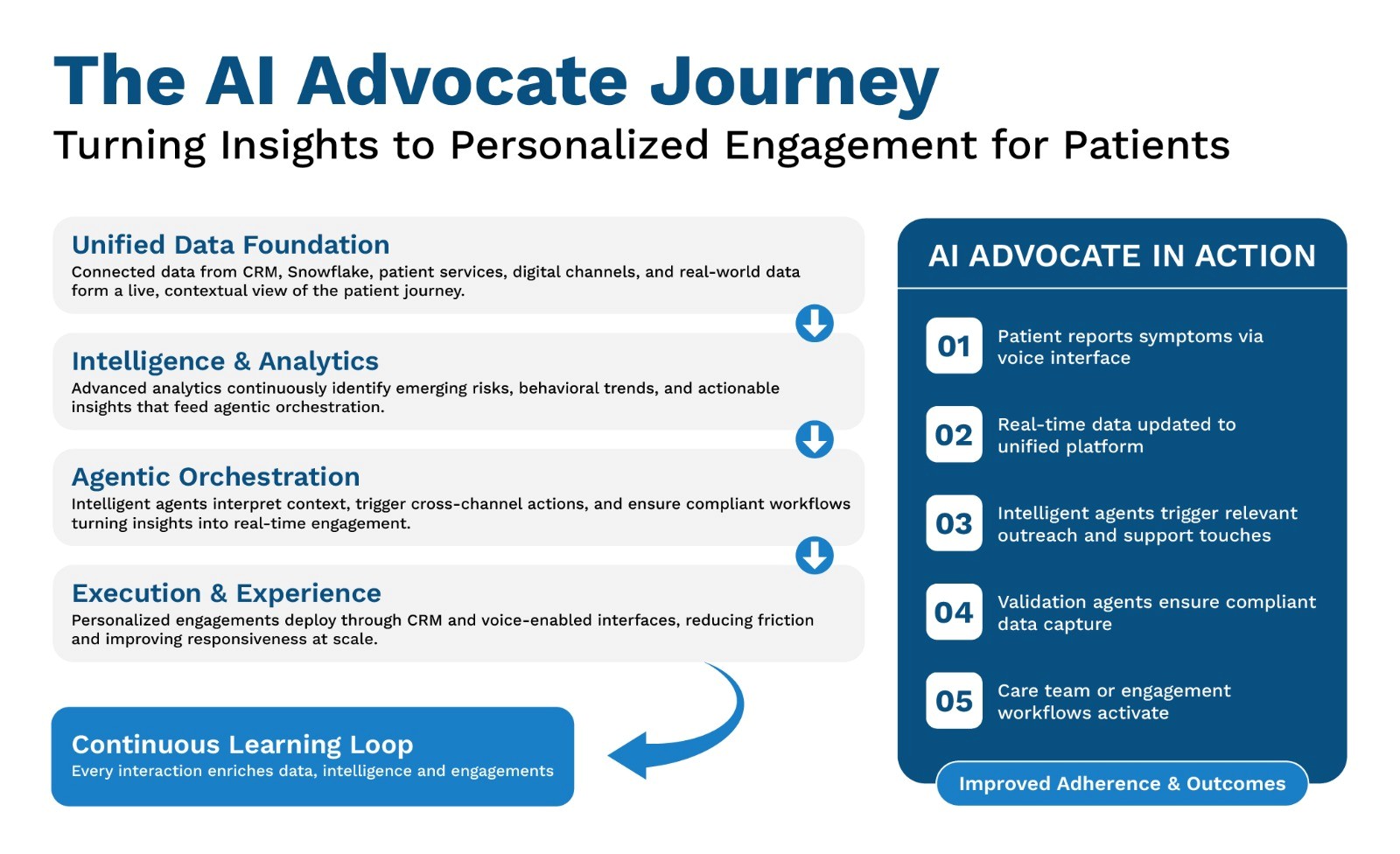
Rather than producing periodic recommendations or static next-best-action reports, the AI advocate model leverages agentic AI to continuously monitor real-time data across Snowflake, CRM platforms, digital channels, and patient services. Intelligent agents interpret context, identify emerging barriers, and orchestrate actions automatically as journeys unfold.

Voice-enabled interfaces further remove friction from engagement. Patients, support teams, and field representatives can interact naturally with systems that understand context and trigger workflows instantly. This transforms engagement into a responsive ecosystem — one that adapts as patient needs change, rather than reacting after issues surface.

In practice, AI advocates enable commercial operators to:

  • Orchestrate real-time next-best actions across channels, triggering personalized outreach, education, and support workflows as patient and provider signals evolve.
  • Embed compliance and data quality directly into execution, using validation agents to ensure interactions meet regulatory standards while strengthening downstream analytics.
  • Unify fragmented touchpoints into a continuous journey view, connecting CRM activity, patient services, digital engagement, and real-world data in real time.
  • Scale personalization without operational complexity, delivering millions of individualized experiences consistently through automated, intelligent workflows.

Connecting Commercial Execution and Patient Journeys

Engagement in life sciences spans commercial teams, medical affairs, patient services, and digital platforms — often operating in parallel with limited coordination. This fragmentation leads to handoffs, delays, and inconsistent experiences for both patients and providers.

Agentic AI advocates act as an orchestration layer across this ecosystem. By maintaining a longitudinal, real-time view of each journey, intelligent agents align actions across functions and systems. Rather than relying on static reports or manual coordination, orchestration happens dynamically as events occur.

This enables organizations to focus on addressing real barriers — whether access challenges, therapy management complexity, or engagement gaps — while analytics continuously optimize strategies in real time.

The framework visually illustrates how unified data feeds intelligence, how agentic orchestration connects insight to execution, and how CRM and voice-enabled engagement deliver real-time experiences — all reinforced through continuous learning. For operators, the outcome is faster response, clearer accountability, and measurably improved engagement effectiveness across the lifecycle.

The Improzo Perspective: From Insight to Real-Time Action

At Improzo, we believe the next phase of commercial transformation is not about adding more tools or generating more insights. It is about turning existing platforms — Snowflake, CRM, analytics,  into systems of real-time action.

  • Agentic AI becomes the connective layer between intelligence and execution. Engagement agents drive personalized actions across channels. Validation agents ensure trust, compliance, and data integrity. Orchestration agents coordinate workflows across commercial, medical, and patient services.
  • Voice-enabled engagement removes friction at the experience layer, making interaction more natural while capturing richer context in real time.

Together, these capabilities close the long-standing gap between analytics and execution. For patients, this creates seamless, proactive, and personalized journeys. For commercial leaders, it delivers measurable improvements in efficiency, engagement performance, and outcomes. The next era of life sciences engagement will not be defined by better insights alone, but by how effectively organizations operate in real time, for every journey.

Gen AI-Enhanced Personalized and Intelligent Analytics

In today’s pharmaceutical environment, executive and commercial leaders face increasing pressures—accelerated product launches, heightened competitive dynamics, stringent compliance requirements, and the critical need to convert vast volumes of data into actionable business intelligence. Conventional dashboards and manual reporting no longer suffice to navigate the speed and complexity of commercial operations. By harnessing advanced AI-driven insights, pharma executives can act swiftly and confidently with proactive, relevant, and easily accessible intelligence designed to drive meaningful commercial outcomes.

AI-Enhanced Analytics: A Game Changer for Pharma Leadership

Anticipating and responding to shifts—whether in market dynamics, product adoption, physician engagement, or patient adherence—before they impact revenue or reputation is essential for pharma boards and commercial leadership. The iZO insights and analytics platform, built upon the latest AI-powered features from advanced data visualization and analytics technologies, empowers organizations with timely, actionable, and context-rich insights engineered to inform high-stakes commercial decisions.

Real-time awareness: Stay on top of sales performance, account health, and launch excellence as they unfold.

Deeper understanding: Instantly grasp why KPIs shift—not just what changed—enabling root-cause analysis and alignment.

Action in the flow of business: Embedded alerts and insights drive frontline decisions, supporting teams both in the field and in the boardroom.

Addressing Limitations of Traditional Solutions

Legacy analytics approaches rely heavily on static dashboards, manual reporting, and a heavy dependence on analytics teams, which present several challenges including:

Static and after-the-fact insights: Traditional dashboards require constant manual monitoring and often deliver insights too late to act effectively.

Information overload: Vast datasets without clear prioritization overwhelm users, making it difficult to focus on what truly matters.

Analytics bottlenecks: Heavy reliance on analytics teams slows down the speed of insight generation and decision-making.

iZO addresses these challenges by seamlessly integrating AI-powered alerting, natural language querying, and scenario modeling—leveraging advanced technologies inspired by Tableau Pulse and Agent—to deliver analytics that are dynamic, accessible, and precisely aligned with evolving business needs

Key Use Cases for Commercial and Executive Leaders

  1. Product Launch Excellence

Challenge: New product launches are highly complex, with critical early signals often buried within sales, distribution, healthcare provider (HCP) engagement, and market access data.

How iZO Helps:

iZO continuously monitors launch KPIs—such as uptake, prescription trends, and formulary changes—and delivers real-time alerts when performance deviates from plan. Advanced AI-driven querying allows leadership to instantly explore market dynamics, asking questions like “What markets saw the largest spike in competitor share this week?” This proactive detection enables early intervention, recalibrating strategy and resources to optimize launch success.

  1. Sales Force Effectiveness

Challenge: Maximizing sales impact requires up-to-date insights on representative performance, physician engagement, and message recall to feed agile coaching and resource allocation.

How iZO Helps:

The platform delivers automated, role-specific notifications directly into collaboration workflows when key metrics dip or fall below thresholds. Conversational AI capabilities enable leaders to investigate sales performance dynamically, for example, “Show me top-performing reps by region and their key activities last quarter.” This fosters alignment across leadership, sales operations, and field teams, eliminating reliance on slow monthly reports.

  1. Market Access & Pricing Response

Challenge: Rapid shifts in payer formularies, competitive pricing, and regional reimbursement require swift, informed action to protect or grow market share.

How iZO Helps:

iZO tracks reimbursement trends and flags unexpected coverage or pricing changes that could threaten revenue. Scenario analysis tools empower executives to explore “what-if” scenarios efficiently, such as estimating the impact of a 10% Medicaid coverage drop in a region. This synthesis of complex data into actionable intelligence supports confident, timely market responses.

  1. Executive Reporting & Board Readiness

Challenge: Executive and board meetings demand not just numbers but contextualized understanding and insights answering “why” and “what’s next.”

How iZO Helps:

The platform auto-generates narrative highlights and causal summaries ahead of reviews, providing clear, plain-language insights. Embedded interactive exploration enables decision-makers to drill into root causes on demand, removing the need for extensive analyst preparation and accelerating data-driven governance conversations.

Why These Features Matter for Pharma Executives

Impact Area Legacy Approach iZO Advantage
Decision Speed Slow, after-the-fact Proactive, real-time alerts and causal insights
Data Accessibility Analysts as gatekeepers Executive-friendly, self-serve natural language interactions
Actionability Manual follow-up required Embedded insights within collaboration and CRM tools
Trust & Governance Ad hoc, inconsistent Certified, governed metrics ensuring compliance

Unlocking Leadership Advantages

Predict Emerging Risks: Detect underperforming accounts, formulary losses, or demand shifts early to prevent widespread issues.

Optimize Resource Allocation: Rapidly deploy sales, marketing, and access resources focused on high-impact regions and accounts.

Enhance Team Agility: Empower commercial teams and affiliates with trusted, instant insights—aligning sales, medical, and market access functions.

Support Strategic Growth: Equip C-suite and board leaders with narrative-rich, actionable intelligence that drives better launch, portfolio, and pricing decisions.

Taking the Next Step

For commercial and executive leaders in pharma, iZO represents a paradigm shift: analytics is no longer just a rearview mirror but a strategic co-pilot enabling forward-looking action. By incorporating the latest AI-powered alerting, natural language querying, and scenario modeling capabilities drawn from industry-leading innovations, iZO transforms how leaders anticipate, respond, and outperform—fueling commercial success and advancing patient care.

Ready to empower your leadership to see further, act faster, and lead smarter? Explore how iZO and its AI-enhanced analytics can elevate your organization’s commercial impact.


Conversational AI Agents in Pharma & Life Sciences: The Improzo iZO™ Framework

Introduction

Pharmaceutical and life sciences organizations are entering a new era of digital transformation, with Conversational AI agents at the forefront. These intelligent systems redefine how companies interact with patients, healthcare professionals (HCPs), and internal team-driving efficiency, compliance, and patient-centricity. The Improzo iZO™ framework is purpose-built to deliver secure, compliant, and scalable Conversational AI tailored to the unique needs of life sciences.

What Are Conversational AI Agents?

Conversational AI agents are advanced digital assistants that use natural language processing and machine learning to simulate human conversation. Unlike basic chatbots, they understand context and intent, delivering accurate, human-like responses across text and voice. In pharma and life sciences, these agents automate patient support, streamline clinical trials, and improve HCP communications while integrating securely with existing systems.

4 Key Benefits of Conversational AI in Pharma & Life Sciences

  • Personalized Patient Engagement: AI agents offer tailored support, answer questions, send reminders, and guide patients, building trust and satisfaction.
  • Efficiency and Cost Savings: Automating routine tasks like scheduling and refills reduces staff workload and costs, letting professionals focus on higher-value care.
  • Omnichannel Access: AI agents provide continuous support across web, mobile, SMS, and voice, ensuring help is always available for patients and HCPs.
  • Data-Driven Insights for Decision-Making: Every interaction generates data that can be analyzed to identify trends and patient needs, supporting proactive care and better organizational decisions.

Overcoming Challenges & How Improzo iZO™ Empowers Life Sciences

Integrating Conversational AI in pharma and life sciences comes with hurdles such as regulatory complexity, fragmented data, legacy infrastructure, and user adoption barriers. The Improzo iZO™ framework addresses these challenges through:

  • Seamless Integration: Connects securely with existing platforms for unified data flow.
  • Compliance: Maintains regulatory alignment and protects sensitive information.
  • Transparency & Trust: Offers clear, explainable outputs and escalation paths.
  • User Adoption: Features intuitive design and training to ensure widespread acceptance.

Improzo iZO™ Framework: Built on Proven Capabilities

  • Comprehensive AI Risk Detection: Automated, industry-specific red teaming uncovers vulnerabilities unique to life sciences data and workflows.
  • Real-Time Guardrails: Immediate threat mitigation and content filtering protect against data leaks, hallucinations, and regulatory breaches.
  • Continuous Compliance Monitoring: Automated dashboards track compliance with FDA, EMA, HIPAA, GDPR, and internal policies—reducing manual audit burdens and accelerating innovation.
  • Scalable and User-Friendly: Whether its a single therapy or a global portfolio, Improzo iZO™ scales effortlessly, with intuitive interfaces that drive adoption internally or across patient and HCP.

Conclusion

Conversational AI is reshaping life sciences by streamlining complex workflows and enabling more personalized, accessible, and proactive care.

  • Drives operational excellence and regulatory compliance
  • Enhances patient and HCP engagement through intelligent automation
  • Positions organizations for future innovation and leadership in healthcare

Unlocking Precision: How AI is Revolutionizing Demand Forecasting for Specialty Medicines

In the fiercely competitive pharmaceutical landscape, accurate demand forecasting is paramount, particularly for high-value specialty medicines. Traditional methods, while foundational, often struggle to capture the complexities of these therapies, leading to costly miscalculations and missed opportunities. Artificial intelligence (AI) offers a transformative solution, enabling us to move beyond guesswork and unlock unprecedented forecasting precision. This blog explores how AI is revolutionizing demand forecasting for specialty medicines, enhancing established methodologies like patient-based and patient flow forecasting, and driving more effective commercial strategies.

The Unique Forecasting Challenges of Specialty Medicines:

Specialty medicines present a distinct set of forecasting hurdles:

  • Data Scarcity: Often recently launched, these therapies lack the robust historical sales data crucial for traditional time-series analysis.
  • Complex Patient Journeys: Intricate diagnostics, specialized distribution networks, and ongoing patient monitoring create multifaceted demand drivers that are difficult to quantify.
  • Pricing & Reimbursement Volatility: High price points and complex payer reimbursement policies introduce significant uncertainty into demand projections.
  • Rapid Market Dynamics: The specialty market is characterized by rapid evolution, with new therapies and evolving treatment guidelines constantly reshaping the landscape.
  • Sensitivity to External Factors: Regulatory changes, clinical trial outcomes, and even public perception can significantly influence demand.

Traditional Forecasting: Strengths and Limitations:

Traditional forecasting methods, while providing a valuable framework, have inherent limitations when applied to specialty medicines:

  • Patient-Based Forecasting: This approach focuses on estimating the number of eligible patients and their treatment duration, leveraging epidemiological data, patient segmentation, treatment adoption rates, and drop-off rates. Challenge: Accurately estimating the eligible patient pool, predicting treatment adoption (influenced by access, physician preferences, and patient behavior), and modeling attrition can be particularly challenging for rare diseases or complex treatment pathways.
  • Patient Flow Forecasting: This approach models the patient journey through various treatment stages, from diagnosis to discontinuation, considering diagnosis rates, treatment initiation, line of therapy progression, and duration of therapy. Challenge: Mapping complex patient journeys and accurately estimating transition probabilities between stages, especially with limited real-world data, presents a significant obstacle.

AI: Elevating Traditional Forecasting and Driving Innovation:

AI is not about replacing established forecasting methodologies; it’s about augmenting them, adding layers of granularity, adaptability, and predictive power.

  1. Precision Patient Identification (Patient-Based Enhancement): AI algorithms can analyze complex datasets, including unstructured data like physician notes within EMRs, to identify patients who meet specific diagnostic criteria with remarkable precision, even for rare diseases with nuanced indicators.
  2. Dynamic Treatment Adoption Modeling (Patient-Based Enhancement): AI moves beyond static adoption rates. It incorporates a wider range of influencing factors – patient preferences, physician prescribing habits, access to specialty pharmacies, the evolving reimbursement landscape, and even social media sentiment – to generate more dynamic and accurate predictions.
  3. Realistic Attrition Modeling (Patient-Based Enhancement): AI models patient attrition dynamically, leveraging real-world data on treatment response, side effects, adherence, and other contributing factors to provide a more nuanced understanding of patient population evolution.
  4. Automated Patient Journey Mapping (Patient Flow Enhancement): AI automates the complex process of mapping patient journeys, learning transition probabilities between treatment stages directly from real-world data sources, enabling more dynamic and accurate patient flow models.
  5. Predictive Transition Probabilities (Patient Flow Enhancement): AI can predict the likelihood of a patient transitioning between treatment lines, considering factors like disease progression, treatment effectiveness, and physician preferences, resulting in more accurate demand forecasts for various lines of therapy.
  6. Seamless Real-World Evidence Integration (Both Methodologies): AI seamlessly integrates real-world evidence (RWE) from diverse sources, bridging the gap between clinical trial data and real-world patient experience for more relevant and actionable forecasts.
  7. Granular Patient Segmentation & Personalized Forecasting: AI enables granular patient segmentation based on individual characteristics and treatment journeys, facilitating highly targeted resource allocation and marketing strategies.
  8. Continuous Learning & Adaptive Forecasting (Both Methodologies): AI models continuously learn and adapt as new data becomes available, ensuring dynamic and responsive forecasting in the rapidly evolving specialty medicine market.

Beyond Enhancement: Emerging AI-Driven Capabilities:

AI offers capabilities that transcend simply improving existing methods:

  • Predictive Analytics for Proactive Decision-Making: AI can predict future demand based on complex patterns and relationships in the data, enabling proactive commercial strategies.
  • Scenario Planning for Strategic Advantage: AI facilitates sophisticated “what-if” analyses, simulating the impact of various factors (e.g., new market entrants, reimbursement changes) on demand.
  • Automated Reporting & Actionable Insights: AI can automate the generation of reports and insights, freeing up analysts to focus on strategic interpretation and action planning.

Implementing AI-Powered Forecasting: A Strategic Imperative:

Successful implementation requires:

  • Data Accessibility & Quality: Access to diverse, high-quality data is non-negotiable.
  • Specialized AI Expertise: Investing in data scientists and AI specialists is essential.
  • Robust Technological Infrastructure: A robust IT infrastructure is critical to support AI-driven analytics.
  • Cross-Functional Collaboration: Collaboration between forecasting, commercial, and IT teams is paramount.

The Future of Forecasting: Intelligent & Data-Driven:

AI is transforming demand forecasting for specialty medicines. By enhancing traditional methodologies and unlocking new capabilities, it provides the deep understanding of patient dynamics necessary for commercial success. Embracing AI-driven forecasting is no longer a competitive advantage—it’s a strategic imperative. Those who proactively invest in these capabilities will be best positioned to navigate the complexities of the specialty medicine market and drive sustainable growth.

Boosting Sales Force Effectiveness in Pharmaceuticals: Harnessing the Power of Generative AI

In the competitive pharmaceutical landscape, enhancing sales force effectiveness is essential for driving commercial success. Generative AI (Gen AI) emerges as a transformative technology that redefines established methodologies, offering innovative solutions to elevate various facets of sales operations. This blog explores how generative AI solutions are differentiated from current approaches, focusing on sales force sizing and placement, customer targeting, territory optimization, call planning, performance measurement, and incentive compensation.

1. Sales Force Sizing and Placement

Current methods for sales force sizing rely heavily on static models, historical averages, or analog-based benchmarks. These approaches often use historical revenue data or workload analysis to determine the number of representatives required in each territory. While these methods provide a starting point, they lack adaptability to real-time market changes or variations in HCP behavior. For example:

Static Revenue Models: Assign resources based on past sales performance without accounting for emerging markets or shifts in demand.

Workload Analysis: Estimates representative needs based on call frequencies and engagement time but fails to incorporate dynamic factors like HCP responsiveness or competitive activity.

Generative AI Advantage:

With Generative AI, it is possible to integrate diverse datasets-historical sales data, market potential, and real-time HCP engagement metrics-to recommend optimal sales force sizes and placements dynamically. Unlike static models, Gen AI based solutions can adapt to changing market conditions by:

  • Continuously analysing demand fluctuations and prescribing patterns.
  • Efficiently simulating multiple scenarios to optimize resource allocation.
  • Preventing over-resourcing in low-potential areas while ensuring adequate coverage in high-growth regions.

2. Targeting the right customers effectively

Traditional customer targeting uses broad segmentation approaches based on limited criteria such as geography, specialty, or prescribing volume. These strategies often fail to capture the nuances of individual HCP preferences or behaviours:

One-Size-Fits-All Segmentation: Treats all HCPs within a segment similarly, missing opportunities for personalized engagement.

Reactive Targeting: Relies on past prescribing data without proactively identifying high-potential customers.

Generative AI Advantage:

Gen AI can enable hyper-personalized targeting by analysing more extensive datasets, including not just prescribing patterns but also digital engagement behaviors, and demographic details.It can help achieve:

  • Predictive Segmentation: Identifying high-potential HCPs likely to respond positively to outreach.
  • Tailored Engagement Plans: Generates specific recommendations for discussion topics, preferred communication channels, and timing-ensuring every interaction is relevant and impactful.

3. Optimizing Territory Alignments

Existing territory design and optimization methodologies are not dynamic enough to effectively adapt to shifts in market dynamics. They also rarely take into consideration inputs such as HCP engagement preferences and access restrictions while identifying total workload.

  • Static Alignments: Territories are rarely reassessed unless triggered by major restructuring.
  • Inefficient Workload Distribution: Leads to overburdened representatives in high-demand areas while underutilizing others in low-demand regions.

Generative AI Advantage:

Gen AI based solutions can help continuously optimize territories by analysing real-time geographic and demographic data alongside market potential. It can ensure:

  • Balanced workloads across representatives at all times.
  • Dynamic adjustments based on HCP engagement trends or competitive activity.
  • Improved coverage of high-priority areas without overextending resources.

4. Streamlining Call Planning

Call planning is often manual or rule-based, relying on rigid frequency targets (e.g., X calls per month per HCP). This approach lacks flexibility and fails to account for individual HCP preferences or availability:

  • Frequency-Based Planning: Focuses on quantity over quality of interactions.
  • Generic messaging: Representatives often approach calls with standard scripts that may not address specific HCP needs.

Generative AI Advantage:

Gen AI can help transform call planning by leveraging historical engagement data and real-time insights:

  • Intelligent Call Scheduling: Recommends optimal call times based on HCP availability and responsiveness patterns.
  • Customized Agendas: Tailors each interaction with relevant product information and discussion points aligned with the HCP’s preferences-fostering deeper connections.

5. Measuring Sales Force Performance

Performance measurement traditionally relies on retrospective metrics such as quarterly sales reports or call activity logs. These lagging indicators provide limited visibility into ongoing trends or emerging issues. Typical challenges faced while measuring performance are:

  • Delayed Insights: Reactive reporting often results in missed opportunities for timely interventions.
  • Narrow Metrics Focus: Emphasizes quantitative KPIs like call volume over qualitative factors like engagement quality.

Generative AI Advantage:

With Gen AI, performance measurement can be enhanced with real-time analytics and predictive modelling:

  • Dynamic Dashboards: Provide real time insights into KPIs such as conversion rates, territory performance, and customer satisfaction.
  • Proactive Interventions: Predictive analytics can identify potential issues early, enabling timely course corrections that improve overall productivity.

6. Enhancing Incentive Compensation Strategies

Established Approaches:

Incentive structures are often based on historical performance metrics without accounting for evolving market conditions or individual preferences:

  • Fixed Compensation Models: There is lack flexibility and personalization in incentive plans with a single plan structure applied to all field force personnels
  • Delayed insights: Sales teams often get delayed insights into their performance, preventing them to take corrective action in time.

Generative AI Advantage:

Gen AI revolutionizes incentive compensation by simulating multiple scenarios using real-time data:

  • Personalized Compensation Plans: With Generative AI, it will be possible to analyse behavioural data to understand motivational drivers of the field and appropriately design IC options to choose from, thus making them more personalized
  • Real time insights and Field Support: Generative AI will enable real time and predictive insights powered by historical data, market trends and customer preferences. This will better equip the field force to gauge the impact of their activity and ensure a successful sales cycle.

Conclusion

Generative AI represents a paradigm shift from traditional methodologies in enhancing sales force effectiveness within the pharmaceutical industry. By addressing the limitations of static models, broad segmentation strategies, and reactive reporting systems, Gen AI introduces precision, adaptability, and scalability into every aspect of sales operations. As we advance further into 2025 and beyond, leveraging generative AI will be critical for maintaining a competitive edge in an increasingly complex marketplace. By integrating real-time data analytics, predictive insights, and personalized engagement strategies at scale, pharmaceutical companies can unlock new levels of efficiency and effectiveness-ultimately driving better outcomes for their organizations and the healthcare providers they serve.