

From Decks to Engines: How Generative AI Is Reshaping Pharma Commercial Execution

Over the past decade, pharmaceutical organizations have invested heavily in modernizing their data infrastructure. Commercial ecosystems now include CRM platforms, omnichannel engagement systems, commercial data warehouses, and increasingly sophisticated analytics environments designed to support brand strategy, field execution, and market access planning. Despite these investments, the operational model through which many leadership decisions are made has evolved far less than the technology stack supporting them. In many commercial organizations, analytical turnaround for leadership updates still ranges from several days to multiple weeks.

Before major leadership moments—such as National Sales Meetings (NSMs), Quarterly Business Reviews (QBRs), or strategic brand updates—organizations typically request a familiar set of analyses: brand performance diagnostics, market share trends, field execution summaries, and competitive intelligence updates. Analytics teams and vendor partners assemble datasets, reconcile metrics, generate models, and ultimately produce presentation decks that summarize the latest performance signals.

The analytical rigor behind these deliverables is often strong. However, the process introduces a structural constraint: latency of insight. Markets evolve faster than reporting cycles. Access dynamics shift, competitor narratives change, and HCP behavior adapts continuously. When insight generation depends on manual analytical workflows, organizations often respond only after signals have already matured. Generative AI introduces the possibility of a fundamentally different operating model—one in which commercial organizations rely less on periodic reporting cycles and more on intelligence engines capable of answering operational questions in near real time. The question facing leadership teams is therefore increasingly straightforward: are organizations still producing decks to interpret the past, or are they building systems capable of continuously interpreting the present?

The Rise of Answer Engines in Pharma

Across industries, generative AI is changing how professionals interact with data.

Instead of navigating dashboards or requesting analyses from analytics teams, users increasingly ask direct questions:

  • What changed in prescribing trends this quarter?
  • Which territories are underperforming relative to opportunity?
  • Where are payer restrictions creating access friction?

Modern AI systems can synthesize answers across structured and unstructured datasets and generate contextual explanations aligned with these questions. Within pharmaceutical organizations, this capability enables the emergence of domain-specific answer engines—systems designed to continuously analyze commercial, medical, and engagement data and translate those signals into decision-ready intelligence.

Rather than waiting weeks for analyses to be produced, leadership teams can increasingly interact directly with their enterprise data ecosystem. The underlying signals already exist within CRM systems, prescription datasets, scientific intelligence sources, and payer data environments. What changes is the organization’s ability to interpret those signals dynamically and present them in a form that supports operational decisions.

The Pharma Intelligence Engine Framework

As generative AI adoption accelerates, several intelligence engines are likely to become foundational components of commercial and medical operations in pharma. A practical way to understand this transition is through four intelligence engines that together translate fragmented enterprise data into actionable insights.
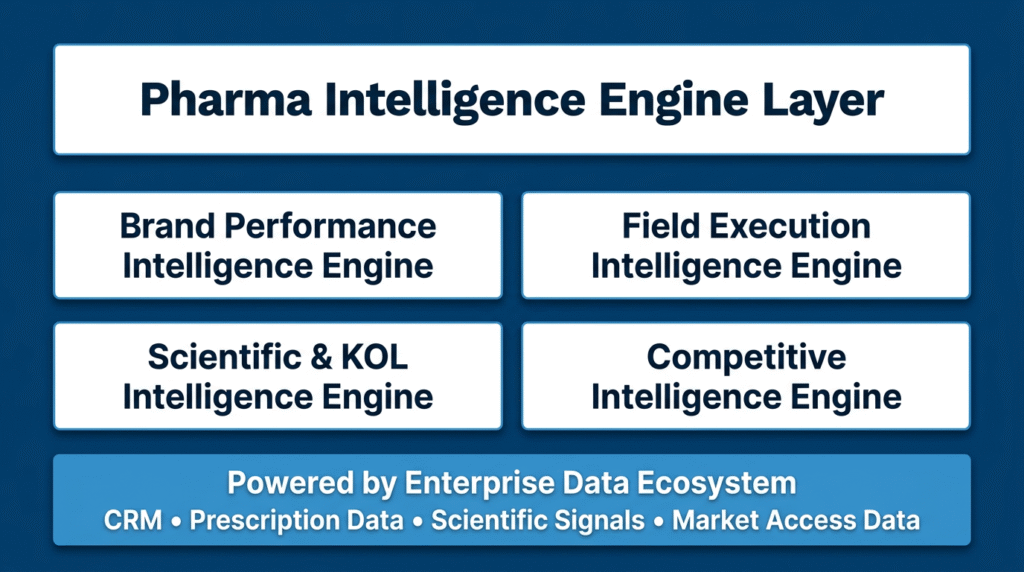
Intelligence Engine Same Question Answered Primary Data Sources Operational Impact
Brand Performance Engine What is driving brand performance right now? Prescription data, payer coverage, patient journey signals Identifies performance drivers and emerging market shifts
Field Execution Engine Where should the field focus next? CRM engagement data, physician behavior patterns Prioritizes next-best actions for field teams
Scientific & KOL Intelligence Engine Who is shaping scientific conversation? Publications, congress activity, trial updates Guides medical engagement strategy
Competitive Intelligence Engine What has changed in the competitive landscape? Trial pipelines, regulatory signals, physician sentiment Enables faster competitive response

In traditional analytics models, these questions are answered through periodic analyses generated by internal analytics teams or external partners. In an intelligence-engine model, systems continuously monitor enterprise data environments and generate answers dynamically. This shift enables leadership teams to move from episodic reporting toward continuous situational awareness across commercial and medical operations.

Early Signals from Biotech Adoption

Several emerging biotechnology companies are already experimenting with this model. One oncology-focused biotech recently deployed a generative AI layer across its commercial and medical data ecosystem to enable real-time intelligence generation. Rather than replacing existing analytics infrastructure, the system acts as an AI overlay that interprets signals across multiple platforms.

As one commercial leader described the shift:

“Instead of asking our analytics partners to prepare decks for every leadership meeting, we can now ask the system the same questions directly. It sits on top of our existing ecosystem and helps leadership get answers immediately.”

The result is not the elimination of analytics teams, but a change in how intelligence flows through the organization. Teams spend less time preparing slides and more time acting on insights.

The Emerging Execution Layer

For many pharmaceutical organizations, the challenge today is no longer the availability of data or the maturity of analytics infrastructure. Most companies have already built substantial commercial data ecosystems that include CRM platforms, omnichannel engagement systems, and advanced analytics environments. What is often missing is the architectural layer that connects these signals and translates them into decision-ready intelligence for leadership teams.

Increasingly, organizations are introducing AI-driven execution layers that operate across the existing technology stack, synthesizing signals from multiple enterprise systems and generating contextual answers aligned with operational questions. Rather than replacing infrastructure, these systems function as an interpretive layer across the enterprise data environment, enabling commercial and medical leaders to move from periodic analysis toward continuous decision support. The objective of this architectural layer is to enable generative AI execution environments that unify commercial data, CRM systems, and scientific intelligence into a single operational reasoning layer.

From Analytics Infrastructure to Decision Infrastructure

The pharmaceutical industry has already invested heavily in data platforms and analytics environments designed to support commercial operations. The next phase of transformation is therefore less about collecting additional data and more about enabling organizations to interpret the signals they already possess.

Generative AI provides the foundation for this shift. When deployed within a structured intelligence architecture, it enables organizations to move beyond periodic reporting cycles toward systems capable of continuously synthesizing data and generating insights aligned with leadership questions. In increasingly complex therapeutic markets, competitive advantage will depend less on the volume of reporting produced and more on the ability of organizations to generate timely, decision-ready intelligence from the data ecosystems they have already built.

From Agentic AI to Agentic Decision Infrastructure

Why AI-Native Execution Infrastructure Is Becoming the Differentiator in Life Sciences

Executive Summary

Life sciences organizations are entering a phase where agentic AI platforms can continuously synthesize scientific literature, field insights, engagement data, and performance signals, representing a meaningful evolution beyond traditional analytics that historically relied on periodic reporting cycles and substantial manual interpretation. Early deployments suggest that agentic capability alone does not resolve decision latency; when agents operate on fragmented definitions, inconsistent context, and limited institutional memory, organizations may accelerate output generation without materially improving decision quality. The next stage of maturity therefore centers on decision infrastructure, where AI-native execution infrastructure enables agentic systems to operate with continuity, traceability, and shared context, transforming analytics from episodic insight generation into continuous decision support.

AI-Native Execution Infrastructure

As life sciences organizations expand their adoption of agentic AI, a new category is emerging that extends beyond analytics platforms and conversational copilots. AI-native execution infrastructure represents a vertically integrated intelligence layer embedded directly within pharmaceutical workflows, designed to close the last-mile gap between insight and action. Rather than requiring re-platforming, this model activates intelligence within existing CRM, data, and analytics environments.

This shift reflects a broader evolution in the market. Competitive advantage is no longer defined solely by analytical sophistication but by how effectively intelligence is operationalized at the point of decision across commercial, medical, and patient workflows.

The Market Shift: From Agents to Operating Layer

The emergence of agentic platforms signals a structural shift in how analytics is consumed. Users increasingly expect systems to interpret signals proactively and surface context-aware recommendations within existing workflows rather than requiring navigation across dashboards and analyses.

Many implementations remain additive, layering agents onto fragmented analytical environments where definitions, relationships, and historical context vary across teams. In these settings, agents improve productivity but often reproduce interpretation gaps at greater speed, creating a paradox in which organizations experience more insight output while decision friction persists. The competitive frontier is therefore shifting toward platforms that coordinate interpretation before automation. Sustained advantage will be defined less by the number of agents deployed and more by the coherence of the intelligence architecture supporting them.

Differentiation in the Life Science Agentic Landscape

The current generation of agentic platforms in life sciences has largely focused on accelerating discrete analytical tasks such as retrieval, summarization, and conversational insight access. While these capabilities deliver measurable productivity gains, they often operate as overlays on fragmented data ecosystems and do not fully resolve the structural execution gap between insight and action.

AI-native execution infrastructure approaches this challenge differently. Instead of positioning agents as standalone interfaces, intelligence is embedded directly into workflows through a coordinated architecture that combines semantic context, domain-trained agents, and workflow orchestration. This enables consistent interpretation, traceable reasoning, and actionable outputs within CRM, medical, and planning environments. The distinction is subtle but material: accelerating tasks improves efficiency, while embedding intelligence into execution infrastructure improves decision velocity.

The Role of the Semantic Layer in Agentic Platforms

The semantic layer establishes a shared decision language by connecting entities, relationships, and historical context across data sources, often implemented as a context graph that captures how HCPs, accounts, scientific themes, and activities relate over time. Rather than treating analytical tasks as independent exercises, this approach enables cumulative understanding that persists across teams, use cases, and time.

Within agentic platforms, this allows recommendations to reflect consistent definitions of HCPs, accounts, scientific themes, and strategic priorities. Insights become traceable to underlying signals, cross-functional alignment improves, and duplication of analysis declines. As organizations scale agentic adoption, the semantic layer increasingly governs how intelligence is generated, validated, and applied. Differentiation therefore shifts from model capability toward architectural coherence.

In one such use case, a medical team at a top biopharma implemented a semantic layer and was able to consolidate literature synthesis, field insights, and qualitative feedback into a unified interpretation workflow, significantly reducing recurring reporting effort.

“They not only incorporated our suggestions but also introduced additional features, such as sentiment analysis, which has been particularly valuable. This enhancement has considerably reduced the time and effort previously required for generating weekly and monthly reports for the medical team.”

Senior Medical Director, Top 20 Life Sciences

A Practical Framework: Agentic Decision Maturity

Organizations adopting agentic AI progress through stages that reflect how intelligence is operationalized within decision workflows. The transition is less about deploying more agents and more about embedding shared context, governance, and learning loops that allow decisions to evolve continuously.

  1. AI-Assisted Productivity:
    AI accelerates discrete analytical tasks such as summarization, literature review, and insight synthesis, improving efficiency while leaving decision workflows largely unchanged.
  1. Agentic Exploration:
    Agents synthesize signals across sources, enabling dynamic exploration of questions while reducing analytical bottlenecks and insight cycles.
  1. Contextual Intelligence (Semantic Foundation):
    A semantic layer introduces shared definitions, relationships, and institutional memory, enabling consistent interpretation across commercial and medical teams.
  1. Workflow-Embedded Decision Support:
    Intelligence is integrated into CRM, medical, and planning workflows, delivering context-aware recommendations at the point of decision and increasing adoption.
  2. Continuous Adaptive Decisioning
    Signals, actions, and outcomes form feedback loops that refine recommendations over time, establishing agentic intelligence as an operating layer.

Organizational Implications

The shift toward AI-native execution infrastructure reshapes analytics roles and leadership engagement with data.

  • Analyst role evolution: As organizations adopt AI-native execution infrastructure, the role of analysts shifts meaningfully toward framing business problems, validating outputs, and designing decision workflows rather than producing recurring reports, while new hybrid roles emerge that combine domain expertise, AI orchestration, and product thinking.
  • Leadership engagement: At the leadership level, engagement with data becomes more continuous and interactive, with leaders moving beyond periodic review cycles to engage regularly with synthesized context, improving responsiveness to market changes and reducing reliance on ad hoc analytical requests.
  • Trust, Governance, and Adoption: Over time, trust emerges as the central driver of adoption, as explainability, governance, and clearly defined boundaries for AI usage determine whether recommendations influence decisions, positioning organizations that treat semantic context as infrastructure to scale more effectively.

Conclusion

The defining competitive question in life sciences is no longer whether organizations adopt agentic AI, but whether those agents operate on shared context that enables consistent interpretation and sustained learning. AI-native execution infrastructure represents the foundation of this transition, allowing agentic platforms to move beyond task automation toward true decision acceleration. This shift transforms analytics from a supporting function into an operating layer embedded across commercial and medical workflows. In an environment characterized by increasing specialization, launch complexity, and faster scientific change, organizations that invest in execution infrastructure will be better positioned to translate agentic capability into sustained strategic advantage.