

From Decks to Engines: How Generative AI Is Reshaping Pharma Commercial Execution

Over the past decade, pharmaceutical organizations have invested heavily in modernizing their data infrastructure. Commercial ecosystems now include CRM platforms, omnichannel engagement systems, commercial data warehouses, and increasingly sophisticated analytics environments designed to support brand strategy, field execution, and market access planning. Despite these investments, the operational model through which many leadership decisions are made has evolved far less than the technology stack supporting them. In many commercial organizations, analytical turnaround for leadership updates still ranges from several days to multiple weeks.

Before major leadership moments—such as National Sales Meetings (NSMs), Quarterly Business Reviews (QBRs), or strategic brand updates—organizations typically request a familiar set of analyses: brand performance diagnostics, market share trends, field execution summaries, and competitive intelligence updates. Analytics teams and vendor partners assemble datasets, reconcile metrics, generate models, and ultimately produce presentation decks that summarize the latest performance signals.

The analytical rigor behind these deliverables is often strong. However, the process introduces a structural constraint: latency of insight. Markets evolve faster than reporting cycles. Access dynamics shift, competitor narratives change, and HCP behavior adapts continuously. When insight generation depends on manual analytical workflows, organizations often respond only after signals have already matured. Generative AI introduces the possibility of a fundamentally different operating model—one in which commercial organizations rely less on periodic reporting cycles and more on intelligence engines capable of answering operational questions in near real time. The question facing leadership teams is therefore increasingly straightforward: are organizations still producing decks to interpret the past, or are they building systems capable of continuously interpreting the present?

The Rise of Answer Engines in Pharma

Across industries, generative AI is changing how professionals interact with data.

Instead of navigating dashboards or requesting analyses from analytics teams, users increasingly ask direct questions:

  • What changed in prescribing trends this quarter?
  • Which territories are underperforming relative to opportunity?
  • Where are payer restrictions creating access friction?

Modern AI systems can synthesize answers across structured and unstructured datasets and generate contextual explanations aligned with these questions. Within pharmaceutical organizations, this capability enables the emergence of domain-specific answer engines—systems designed to continuously analyze commercial, medical, and engagement data and translate those signals into decision-ready intelligence.

Rather than waiting weeks for analyses to be produced, leadership teams can increasingly interact directly with their enterprise data ecosystem. The underlying signals already exist within CRM systems, prescription datasets, scientific intelligence sources, and payer data environments. What changes is the organization’s ability to interpret those signals dynamically and present them in a form that supports operational decisions.

The Pharma Intelligence Engine Framework

As generative AI adoption accelerates, several intelligence engines are likely to become foundational components of commercial and medical operations in pharma. A practical way to understand this transition is through four intelligence engines that together translate fragmented enterprise data into actionable insights.
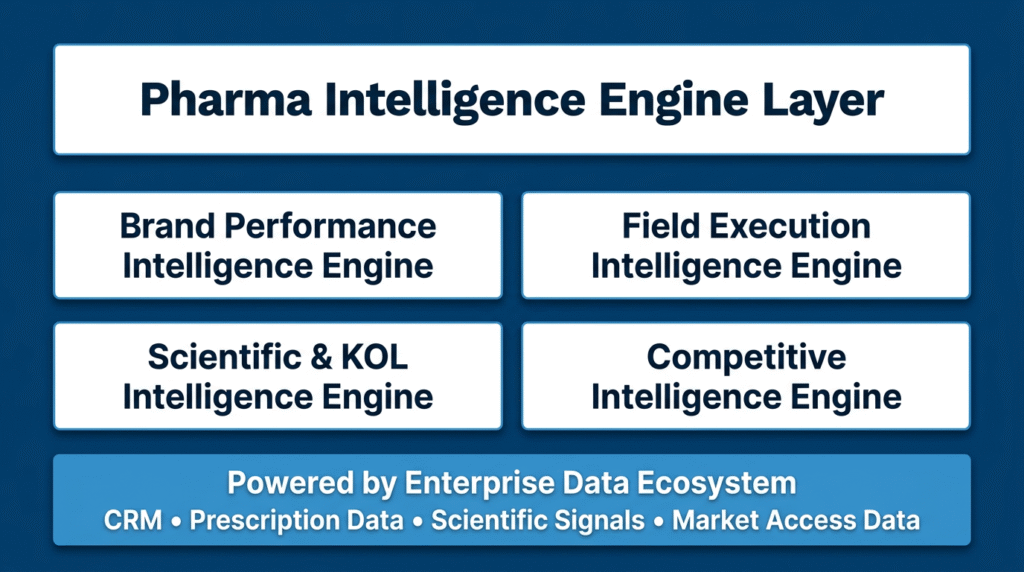
Intelligence Engine Same Question Answered Primary Data Sources Operational Impact
Brand Performance Engine What is driving brand performance right now? Prescription data, payer coverage, patient journey signals Identifies performance drivers and emerging market shifts
Field Execution Engine Where should the field focus next? CRM engagement data, physician behavior patterns Prioritizes next-best actions for field teams
Scientific & KOL Intelligence Engine Who is shaping scientific conversation? Publications, congress activity, trial updates Guides medical engagement strategy
Competitive Intelligence Engine What has changed in the competitive landscape? Trial pipelines, regulatory signals, physician sentiment Enables faster competitive response

In traditional analytics models, these questions are answered through periodic analyses generated by internal analytics teams or external partners. In an intelligence-engine model, systems continuously monitor enterprise data environments and generate answers dynamically. This shift enables leadership teams to move from episodic reporting toward continuous situational awareness across commercial and medical operations.

Early Signals from Biotech Adoption

Several emerging biotechnology companies are already experimenting with this model. One oncology-focused biotech recently deployed a generative AI layer across its commercial and medical data ecosystem to enable real-time intelligence generation. Rather than replacing existing analytics infrastructure, the system acts as an AI overlay that interprets signals across multiple platforms.

As one commercial leader described the shift:

“Instead of asking our analytics partners to prepare decks for every leadership meeting, we can now ask the system the same questions directly. It sits on top of our existing ecosystem and helps leadership get answers immediately.”

The result is not the elimination of analytics teams, but a change in how intelligence flows through the organization. Teams spend less time preparing slides and more time acting on insights.

The Emerging Execution Layer

For many pharmaceutical organizations, the challenge today is no longer the availability of data or the maturity of analytics infrastructure. Most companies have already built substantial commercial data ecosystems that include CRM platforms, omnichannel engagement systems, and advanced analytics environments. What is often missing is the architectural layer that connects these signals and translates them into decision-ready intelligence for leadership teams.

Increasingly, organizations are introducing AI-driven execution layers that operate across the existing technology stack, synthesizing signals from multiple enterprise systems and generating contextual answers aligned with operational questions. Rather than replacing infrastructure, these systems function as an interpretive layer across the enterprise data environment, enabling commercial and medical leaders to move from periodic analysis toward continuous decision support. The objective of this architectural layer is to enable generative AI execution environments that unify commercial data, CRM systems, and scientific intelligence into a single operational reasoning layer.

From Analytics Infrastructure to Decision Infrastructure

The pharmaceutical industry has already invested heavily in data platforms and analytics environments designed to support commercial operations. The next phase of transformation is therefore less about collecting additional data and more about enabling organizations to interpret the signals they already possess.

Generative AI provides the foundation for this shift. When deployed within a structured intelligence architecture, it enables organizations to move beyond periodic reporting cycles toward systems capable of continuously synthesizing data and generating insights aligned with leadership questions. In increasingly complex therapeutic markets, competitive advantage will depend less on the volume of reporting produced and more on the ability of organizations to generate timely, decision-ready intelligence from the data ecosystems they have already built.


From Agentic AI to Agentic Decision Infrastructure

Why AI-Native Execution Infrastructure Is Becoming the Differentiator in Life Sciences

Executive Summary

Life sciences organizations are entering a phase where agentic AI platforms can continuously synthesize scientific literature, field insights, engagement data, and performance signals, representing a meaningful evolution beyond traditional analytics that historically relied on periodic reporting cycles and substantial manual interpretation. Early deployments suggest that agentic capability alone does not resolve decision latency; when agents operate on fragmented definitions, inconsistent context, and limited institutional memory, organizations may accelerate output generation without materially improving decision quality. The next stage of maturity therefore centers on decision infrastructure, where AI-native execution infrastructure enables agentic systems to operate with continuity, traceability, and shared context, transforming analytics from episodic insight generation into continuous decision support.

AI-Native Execution Infrastructure

As life sciences organizations expand their adoption of agentic AI, a new category is emerging that extends beyond analytics platforms and conversational copilots. AI-native execution infrastructure represents a vertically integrated intelligence layer embedded directly within pharmaceutical workflows, designed to close the last-mile gap between insight and action. Rather than requiring re-platforming, this model activates intelligence within existing CRM, data, and analytics environments.

This shift reflects a broader evolution in the market. Competitive advantage is no longer defined solely by analytical sophistication but by how effectively intelligence is operationalized at the point of decision across commercial, medical, and patient workflows.

The Market Shift: From Agents to Operating Layer

The emergence of agentic platforms signals a structural shift in how analytics is consumed. Users increasingly expect systems to interpret signals proactively and surface context-aware recommendations within existing workflows rather than requiring navigation across dashboards and analyses.

Many implementations remain additive, layering agents onto fragmented analytical environments where definitions, relationships, and historical context vary across teams. In these settings, agents improve productivity but often reproduce interpretation gaps at greater speed, creating a paradox in which organizations experience more insight output while decision friction persists. The competitive frontier is therefore shifting toward platforms that coordinate interpretation before automation. Sustained advantage will be defined less by the number of agents deployed and more by the coherence of the intelligence architecture supporting them.

Differentiation in the Life Science Agentic Landscape

The current generation of agentic platforms in life sciences has largely focused on accelerating discrete analytical tasks such as retrieval, summarization, and conversational insight access. While these capabilities deliver measurable productivity gains, they often operate as overlays on fragmented data ecosystems and do not fully resolve the structural execution gap between insight and action.

AI-native execution infrastructure approaches this challenge differently. Instead of positioning agents as standalone interfaces, intelligence is embedded directly into workflows through a coordinated architecture that combines semantic context, domain-trained agents, and workflow orchestration. This enables consistent interpretation, traceable reasoning, and actionable outputs within CRM, medical, and planning environments. The distinction is subtle but material: accelerating tasks improves efficiency, while embedding intelligence into execution infrastructure improves decision velocity.

The Role of the Semantic Layer in Agentic Platforms

The semantic layer establishes a shared decision language by connecting entities, relationships, and historical context across data sources, often implemented as a context graph that captures how HCPs, accounts, scientific themes, and activities relate over time. Rather than treating analytical tasks as independent exercises, this approach enables cumulative understanding that persists across teams, use cases, and time.

Within agentic platforms, this allows recommendations to reflect consistent definitions of HCPs, accounts, scientific themes, and strategic priorities. Insights become traceable to underlying signals, cross-functional alignment improves, and duplication of analysis declines. As organizations scale agentic adoption, the semantic layer increasingly governs how intelligence is generated, validated, and applied. Differentiation therefore shifts from model capability toward architectural coherence.

In one such use case, a medical team at a top biopharma implemented a semantic layer and was able to consolidate literature synthesis, field insights, and qualitative feedback into a unified interpretation workflow, significantly reducing recurring reporting effort.

“They not only incorporated our suggestions but also introduced additional features, such as sentiment analysis, which has been particularly valuable. This enhancement has considerably reduced the time and effort previously required for generating weekly and monthly reports for the medical team.”

Senior Medical Director, Top 20 Life Sciences

A Practical Framework: Agentic Decision Maturity

Organizations adopting agentic AI progress through stages that reflect how intelligence is operationalized within decision workflows. The transition is less about deploying more agents and more about embedding shared context, governance, and learning loops that allow decisions to evolve continuously.

  1. AI-Assisted Productivity:
    AI accelerates discrete analytical tasks such as summarization, literature review, and insight synthesis, improving efficiency while leaving decision workflows largely unchanged.
  1. Agentic Exploration:
    Agents synthesize signals across sources, enabling dynamic exploration of questions while reducing analytical bottlenecks and insight cycles.
  1. Contextual Intelligence (Semantic Foundation):
    A semantic layer introduces shared definitions, relationships, and institutional memory, enabling consistent interpretation across commercial and medical teams.
  1. Workflow-Embedded Decision Support:
    Intelligence is integrated into CRM, medical, and planning workflows, delivering context-aware recommendations at the point of decision and increasing adoption.
  2. Continuous Adaptive Decisioning
    Signals, actions, and outcomes form feedback loops that refine recommendations over time, establishing agentic intelligence as an operating layer.

Organizational Implications

The shift toward AI-native execution infrastructure reshapes analytics roles and leadership engagement with data.

  • Analyst role evolution: As organizations adopt AI-native execution infrastructure, the role of analysts shifts meaningfully toward framing business problems, validating outputs, and designing decision workflows rather than producing recurring reports, while new hybrid roles emerge that combine domain expertise, AI orchestration, and product thinking.
  • Leadership engagement: At the leadership level, engagement with data becomes more continuous and interactive, with leaders moving beyond periodic review cycles to engage regularly with synthesized context, improving responsiveness to market changes and reducing reliance on ad hoc analytical requests.
  • Trust, Governance, and Adoption: Over time, trust emerges as the central driver of adoption, as explainability, governance, and clearly defined boundaries for AI usage determine whether recommendations influence decisions, positioning organizations that treat semantic context as infrastructure to scale more effectively.

Conclusion

The defining competitive question in life sciences is no longer whether organizations adopt agentic AI, but whether those agents operate on shared context that enables consistent interpretation and sustained learning. AI-native execution infrastructure represents the foundation of this transition, allowing agentic platforms to move beyond task automation toward true decision acceleration. This shift transforms analytics from a supporting function into an operating layer embedded across commercial and medical workflows. In an environment characterized by increasing specialization, launch complexity, and faster scientific change, organizations that invest in execution infrastructure will be better positioned to translate agentic capability into sustained strategic advantage.

Execution-Native AI for Qualitative Market Research

Making Human Insight Reusable Without Replacing Human Judgment

Executive Summary

Qualitative market research remains one of the earliest and most valuable sources of signal in biopharma. Advisory boards, interviews, and field feedback often surface shifts in access, sentiment, and unmet need well before they appear in quantitative data.

Yet much of this insight remains difficult to reuse. Findings live in decks and documents, summarized differently across teams and projects. When similar questions arise later, research is often repeated. The friction is not in generating insight — it is in finding, comparing, and reusing it reliably.

AI is not replacing qualitative research or human interpretation. Its most effective role is operational. Execution-native AI embeds intelligence into the research workflow after data collection. Instead of generating conclusions, it structures qualitative inputs consistently, links insights to evidence, and makes prior research discoverable across brands, markets, and time. Researchers continue to define hypotheses and interpret meaning. AI reduces administrative effort and preserves institutional memory. The result is insight that travels further and lasts longer.

Building an Execution-Native Foundation

Organizations that scale AI in qualitative research embed it directly into the research lifecycle, focusing on consistency, traceability, and reuse.

Core Architectural Components

  • Ingestion of interviews, open-ended responses, field notes, and research archives
  • Automated structuring of unstructured data while preserving context
  • Alignment to existing governed taxonomies across studies
  • Evidence-linked insights traceable to source excerpts
  • Integration with analytics and knowledge systems

This approach turns qualitative research from static output into cumulative enterprise intelligence.

Governance Mechanisms

Governance ensures AI improves consistency and reuse in qualitative research without compromising rigor, accountability, or compliance. Defined model boundaries, evidence traceability, and human oversight ensure insights remain reliable, auditable, and appropriate for both commercial decision-making and medical review processes.

  • Bounded model roles: AI is constrained to specific tasks such as classification or extraction, improving consistency while reducing risk.
  • Human-in-the-loop review: Researchers retain control over high-impact insights and final interpretation.
  • Source traceability and auditability: All synthesized insights remain directly linked to original evidence and study context.
  • Access controls and compliance: Role-based controls ensure sensitive insights are reused securely and in line with regulatory requirements.

From Field Insight to Action

As AI-driven search becomes a primary discovery layer, qualitative insights must be machine-interpretable. Clear, declarative language, direct answers to real questions, and explicit links to supporting evidence allow both humans and AI systems to retrieve and cite insights accurately. In biopharma commercial teams, early signals often emerge through advisory boards and sales feedback, where access barriers, payer dynamics, or shifts in competitor messaging surface first in qualitative conversations.

Execution-native AI structures these insights at ingestion using consistent commercial taxonomies—such as access friction, message resonance, and unmet need—while preserving verbatim context. When teams ask questions like “What access objections are emerging post-launch?”, they can retrieve and compare prior insights across brands and markets without manual re-analysis, enabling faster alignment and better decisions without replacing commercial judgment.

Final Perspective

The future of qualitative market research is not automation of insight. It is execution excellence.

AI should reduce friction, preserve context, and make insight reusable — while leaving interpretation firmly in human hands. When designed correctly, AI does not diminish qualitative research. It allows it to scale.

NBA in Pharma: The Playbook for Pharma Companies to transform their operations

Introduction

Pharma companies are facing a data-driven revolution, with digital innovation and analytics rapidly transforming how they operate and engage with stakeholders. According to a McKinsey report, by 2025, organizations that effectively combine, analyze, and interpret disparate datasets will be best positioned to elevate performance and optimize outcomes for both patients and physicians1. Another McKinsey survey highlights that the winners in this evolving landscape will be those who harness advanced analytics and real-world evidence to inform every interaction and decision.

Challenges in Pharma Operations

Pharma companies are grappling with a rapidly evolving landscape that demands smarter, more agile operations. Here are the key challenges-and what could be done to address them:

  • Fragmented Data Ecosystems:
    Most organizations still operate with data scattered across CRM systems, EHRs, marketing platforms, and external sources. This fragmentation makes it difficult to generate a unified, actionable view of HCPs. By investing in robust data integration and cloud-based platforms, pharma could lay the groundwork for more intelligent engagement.
  • Lack of Personalization and Relevance:
    HCPs are inundated with generic, repetitive communications that fail to address their specific needs or preferences. Companies could deploy advanced analytics and AI-driven content engines to tailor messaging, ensuring each interaction is timely, relevant, and valuable.
  • Inefficient Resource Allocation:
    Sales and medical field teams often spend significant time on administrative tasks or low-value activities, reducing their impact. By adopting AI-powered prioritization and route optimization techniques proven in logistics and retail-pharma could ensure that resources are focused where they matter most.
  • Compliance and Regulatory Complexity:
    With strict regulations governing every interaction, the risk of non-compliance is ever-present. Real-time compliance monitoring and anomaly detection, inspired by financial services and cybersecurity, could help pharma proactively identify and mitigate risks.
  • Siloed Operations and Slow Decision-Making:
    Disconnected teams and manual processes slow down response times and hinder agility. By embracing cross-functional collaboration tools and intelligent automation, companies could accelerate decision-making and adapt faster to market changes.

According to a recent industry study, by 2027, 83% of HCP engagements are expected to be orchestrated by AI-driven NBA platforms. This underscores the urgency for pharma to address these challenges and modernize their operations.

What is Next Best Action?

With HCPs flooded with multiple messages & change in the pharma landscape, a data driven & ML/AI led Next Best Action (NBA) approach is the way ahead. NBA enables the sales & marketing teams to reach HCPs through the right channel, with the right frequency & with correct content. This would increase the promotional impact of the teams, thus enhancing the efficacy of their efforts.

How does Next Best Action work?

NBAs leverage distinct & large amounts of data to recommend individual HCP-centric content & channels based on past interactions. Using advanced analytics, NBA engine identifies patterns & insights to recommend the best channel to reach out to the HCP. Along with the channel recommendation, the engine would also recommend optimal time to send corporate emails & notify field teams using automated platforms. Along with these recommendations, the NBA would also offer rationale for suggested channels, thus instilling confidence into sales & marketing operations.

How can NBA solution help?

  1. Personalized Marketing Content – Moving away from a generalized targeting strategy, NBA leverages advanced analytics & data to identify best action for each HCP target. This personalization aspect would lead to HCPs being more receptive to the marketing activity
  2. Improved coordination – Sales & marketing teams need to work in harmony, rather than working in silos. With the NBA engine, sales teams would be informed of a corporate email or a centralized marketing effort, thus doing away with disorganization & impersonal communication methodology
  3. NBA based HCP Segmentation – HCP segmentation based on NBA recommendations would enable tailored messaging & personalization in communication to HCPs.
  4. Improved RoI – With decreased costs due to optimal marketing & de-duplication of efforts & resulting prescription lift, NBA could go a long way in increasing the RoI of promotional efforts.

The NBA Framework: Crawl, Walk, Run

Pharma companies are increasingly adopting a “Crawl, Walk, run” approach to NBA implementation, ensuring scalable, sustainable transformation while learning from other industries’ best practices.

Crawl: Laying the AI Foundation

  • Pilot Programs:
    Organizations begin with focused NBA pilots in select brands or channels. These pilots use foundational AI models and rule-based recommendations, providing early insights into engagement improvements and operational bottlenecks.
  • Building Unified Data Repositories:
    The initial phase includes integrating prescription, engagement, and third-party data into a single source of truth, reducing manual data prep and enabling more advanced analytics.

Walk: Scaling Intelligent Orchestration

  • Multichannel Integration:
    As capabilities mature, companies expand NBA to multiple brands and channels, integrating digital, in-person, and virtual touchpoints. AI-driven orchestration, inspired by retail and customer service, routes HCPs to the most effective engagement channels.
  • Predictive Analytics:
    Predictive models, like those used in manufacturing and supply chain optimization, anticipate HCP needs and knowledge gaps, triggering timely, personalized outreach.

Run: Enterprise-Wide Autonomy

  • Agentic AI Systems:
    At this stage, companies deploy autonomous AI agents capable of scheduling, personalizing, and optimizing interactions in real time. These systems continuously learn from engagement data and adjust strategies without manual intervention, mirroring advancements in autonomous marketing and customer service.
  • Self-Optimizing Campaigns:
    Drawing from digital advertising best practices, AI reallocates resources across channels based on real-time performance, ensuring optimal ROI and compliance.

The Future Playbook

Pharma companies are not just adopting NBA-they are evolving their operating models by integrating agentic AI and learning from sectors like retail, logistics, and cybersecurity. Hybrid human-AI teams, real-time compliance audits, and quantum-ready analytics are all on the horizon. According to McKinsey, organizations that lead in advanced analytics and digital transformation will set the standard for value and patient outcomes by 2025.1

By following a structured, phased approach and embracing cross-industry innovation, pharma organizations can unlock the full potential of NBA-delivering smarter engagement, improved compliance, and a competitive edge in the digital era.

Planning commercial success for an upcoming specialty drug launch in 2025

As the pharmaceutical landscape continues to evolve, launching a new specialty drug in 2025 presents both unique opportunities and significant challenges. The rapid growth in specialty medications, particularly in areas like cell and gene therapies, requires commercial technology and analytics leaders to adopt a strategic approach that leverages data-driven insights and innovative engagement tactics. Understanding the key factors that will influence a successful launch is crucial for maximizing market impact and ensuring that new therapies reach the patients who need them most.

Navigating the Complex Landscape

The complexity of launching a specialty drug has intensified in recent years due to increased competition, regulatory scrutiny, and the demand for real-world evidence. As of 2024, specialty medications accounted for nearly 40% of total prescription revenues, underscoring their importance in the pharmaceutical market. However, with this growth comes heightened expectations from stakeholders, including healthcare professionals (HCPs), healthcare insurers payers, and patients.

A successful launch requires not only a robust understanding of the competitive landscape but also an agile approach to market access strategies. Companies must be prepared to navigate payer preferences and health technology assessments (HTAs) while ensuring that their product offers distinct value compared to existing therapies. Furthermore, the COVID-19 pandemic has permanently altered how pharmaceutical companies engage with HCPs. In-person meetings decreased significantly during the pandemic, leading to a surge in digital interactions. In 2025, companies must continue to embrace this digital-first approach while balancing it with traditional engagement methods. Leveraging data analytics to understand HCP preferences for virtual versus in-person interactions will be essential for optimizing outreach efforts.

Key Considerations for Launch Strategy

When planning a new specialty drug launch, commercial technology and analytics leaders should focus on several critical areas:

1. Comprehensive Market Preparation: Begin your launch strategy at least 18-24 months prior to the product’s approval. This preparation should include identifying key opinion leaders (KOLs) and engaging them early in the process to gather insights into their needs and expectations. Establishing relationships with KOLs can facilitate smoother access to HCPs once the drug is launched.

2. Data-Driven Decision Making: Implement advanced analytics tools that integrate multiple data sources, including market research, sales forecasts, and real-world evidence. This data should inform your go-to-market strategy by identifying target segments and tailoring messaging accordingly. A robust Customer Relationship Management (CRM) system will also be vital for tracking interactions with HCPs and managing ongoing relationships post-launch.

3. Digital Engagement Strategy: Develop a comprehensive digital engagement plan that includes virtual meetings, webinars, and online educational content tailored for HCPs. Given that a significant portion of HCP interactions now occur through digital channels, ensuring that your messaging is accessible and engaging is crucial for building awareness and driving adoption.

4. Value Demonstration: Clearly articulate the value proposition of your specialty drug not just from a clinical perspective but also in terms of patient outcomes and cost-effectiveness. Providing real-world evidence demonstrates how the drug improves patient care can help persuade payers and HCPs of its worth.

5. Post-Launch Monitoring and Adaptation: Once your drug is on the market, continuously monitor its performance against key metrics such as sales volume, market share, and HCP engagement levels. Use this data to adapt your strategy as needed—whether that means refining messaging or adjusting promotional tactics based on real-time feedback from the field.

Conclusion

Launching a specialty drug in 2025 requires careful planning and execution across multiple dimensions—from market preparation and data analytics to digital engagement strategies and value demonstration. By embracing these considerations, commercial technology and analytics leaders can position their organizations for success in an increasingly competitive environment. As the pharmaceutical industry continues to transform through technological advancements and changing healthcare dynamics, staying ahead of these trends will be essential for achieving long-term commercial success. Ultimately, a well-executed launch not only drives revenue but also plays a critical role in improving patient access to innovative therapies that can enhance their quality of life.

The Transformative Power of Data Aggregation in Pharmaceuticals: Driving Innovation and Patient-Centric Care

The pharmaceutical industry has undergone a significant transformation in its approach to data aggregation, moving from siloed information to interconnected networks that offer unprecedented insights. This evolution has reshaped how companies understand patient needs, optimize drug development, and improve overall healthcare outcomes.

Many pharmaceutical companies have leveraged data aggregation to advance personalized medicine. By combining genomic data with clinical trial results and real-world evidence, these companies have developed targeted therapies for specific patient subgroups. For instance, targeted therapies for breast cancer are prescribed based on biomarkers like HER2 protein expression levels, demonstrating how data-driven approaches can lead to more effective treatments.

Other common real-life examples deployed at pharma involves implementing comprehensive real-world data (RWD) initiatives to complement traditional clinical trials. By aggregating data from electronic health records, claims databases, and wearable devices, companies gain insights into drug effectiveness and safety in diverse populations. This approach helps refine post-market surveillance for drugs, allowing for rapid identification of potential side effects and more informed decision-making.

Key Aspects of Data Aggregation in Pharma

  1. Patient-Centric Approach

Modern data aggregation in pharma focuses on patient-centric insights. This involves collecting and analyzing data from various touchpoints, including:

  • Patient demographics
  • Medication adherence patterns
  • Clinical outcomes
  • Adverse events
  • Cost metrics

By integrating these diverse data sources, pharmaceutical companies can gain a holistic view of patient experiences and needs.

  • Collaborative Ecosystem

Data aggregation fosters collaboration among stakeholders in the healthcare ecosystem. Many companies have partnered with healthcare providers and technology firms to create data-sharing platforms. This collaboration enables seamless communication between healthcare providers, payers, and pharmaceutical manufacturers, leading to more efficient care coordination and improved patient outcomes.

  • Advanced Analytics and AI

The fusion of comprehensive datasets with AI-driven analytics is revolutionizing drug discovery and development. Pharmaceutical companies are using machine learning algorithms to analyze aggregated clinical and genomic data, helping to identify new drug targets and predict patient responses to treatments. This approach accelerates the drug development pipeline and improves the success rate of clinical trials.

Challenges and Considerations

While data aggregation offers immense potential, it also presents challenges:

  1. Data Privacy: Ensuring patient confidentiality while leveraging vast amounts of health data remains a critical concern.
  2. Data Quality: Maintaining the accuracy and reliability of aggregated data from diverse sources is crucial for deriving meaningful insights.
  3. Interoperability: Overcoming the hurdles of integrating data from disparate healthcare systems requires ongoing technological advancements.

Conclusion

The evolution of data aggregation in pharmaceuticals represents a pivotal shift towards more personalized, efficient, and effective healthcare. By harnessing the power of aggregated data, pharmaceutical companies can drive innovation in drug development, optimize patient care, and ultimately improve health outcomes. As the industry continues to navigate this data-driven era, striking a balance between leveraging data’s potential and upholding ethical standards will be crucial for sustained success and patient trust.

Enhancing Your Commercial Model Design via Medical Science Liaisons

In the pharmaceutical industry, the role of Medical Science Liaisons (MSLs) has evolved significantly since its inception about 50 years ago. Initially focused on promotional activities, MSLs now serve as vital connectors between pharmaceutical companies and the medical community. For commercial technology and analytics leaders, understanding how to effectively integrate MSLs into your commercial model design can enhance engagement with healthcare professionals (HCPs) and ultimately drive better patient outcomes.

Key Challenges Faced by Medical Science Liaisons

Despite their importance, MSLs encounter several challenges that can hinder their effectiveness. One significant challenge is engaging KOLs, who have diverse needs that change over time. MSLs must stay attuned to these evolving preferences but tracking them can be cumbersome without the right tools. Additionally, accessing top KOLs presents a formidable obstacle; busy schedules and gatekeepers often limit MSL availability to these influential figures. This inaccessibility can create barriers to meaningful engagement. Lastly, MSLs face the daunting task of simplifying information consumption amidst an overwhelming amount of data—from clinical trial updates to industry trends. Without streamlined processes for assimilating this information, MSLs may struggle to focus on actionable insights rather than getting lost in data.

Leveraging MSLs for Commercial Model Design

Integrating MSLs into your commercial model design offers several strategic advantages:

  • Enhanced Relationship Management: By equipping MSLs with advanced analytics tools, pharmaceutical companies can empower them to build deeper relationships with KOLs. These tools can help track interactions, preferences, and emerging trends, enabling more personalized engagement strategies.
  • Data-Driven Insights: MSLs are uniquely positioned to gather real-world insights from KOL interactions. By incorporating these insights into your commercial strategy, you can better align your messaging and product offerings with the needs of healthcare providers. This alignment not only enhances engagement but also fosters trust and credibility in your brand.
  • Streamlined Communication Channels: Establishing clear communication channels between MSLs and commercial teams ensures that insights gathered by MSLs are effectively shared across the organization. This collaboration can lead to more informed decision-making regarding marketing strategies, sales approaches, and product development.

Implementing Effective Solutions

To address the challenges faced by MSLs and enhance your commercial model design, pharmaceutical firms consider many viable solutions and strategies such as:

  1. Investing in Technology: Implementing a robust Customer Relationship Management (CRM) system tailored for medical affairs can streamline data collection and analysis for MSLs. This technology should facilitate tracking KOL interactions, preferences, and emerging trends in real time.
  2. Providing effective Training and Support: Continuous training for MSLs on the latest scientific advancements and industry trends is essential. Additionally, equipping them with resources that simplify information consumption will allow them to focus on high-impact activities rather than administrative tasks.
  3. Fostering Cross-Functional Collaboration: Encourage collaboration between MSL teams and other departments such as marketing, sales, and R&D. Regular meetings to share insights from KOL engagements can lead to a more cohesive strategy that aligns with market needs.

The integration of Medical Science Liaisons into your commercial model design is not just an operational enhancement; it is a strategic imperative in today’s competitive pharmaceutical landscape. By recognizing the critical role that MSLs play in bridging the gap between science and commercial success, pharmaceutical companies can leverage their expertise to foster deeper relationships with healthcare professionals, drive informed decision-making, and ultimately improve patient outcomes.

As commercial technology and analytics leaders navigate this evolving landscape, investing in the capabilities of MSLs will be key to achieving long-term success in the pharmaceutical industry. Embracing this approach will not only enhance engagement but also position your organization as a trusted partner in advancing healthcare solutions.