


Over the past decade, pharmaceutical organizations have invested heavily in modernizing their data infrastructure. Commercial ecosystems now include CRM platforms, omnichannel engagement systems, commercial data warehouses, and increasingly sophisticated analytics environments designed to support brand strategy, field execution, and market access planning. Despite these investments, the operational model through which many leadership decisions are made has evolved far less than the technology stack supporting them. In many commercial organizations, analytical turnaround for leadership updates still ranges from several days to multiple weeks.
Before major leadership moments—such as National Sales Meetings (NSMs), Quarterly Business Reviews (QBRs), or strategic brand updates—organizations typically request a familiar set of analyses: brand performance diagnostics, market share trends, field execution summaries, and competitive intelligence updates. Analytics teams and vendor partners assemble datasets, reconcile metrics, generate models, and ultimately produce presentation decks that summarize the latest performance signals.
The analytical rigor behind these deliverables is often strong. However, the process introduces a structural constraint: latency of insight. Markets evolve faster than reporting cycles. Access dynamics shift, competitor narratives change, and HCP behavior adapts continuously. When insight generation depends on manual analytical workflows, organizations often respond only after signals have already matured. Generative AI introduces the possibility of a fundamentally different operating model—one in which commercial organizations rely less on periodic reporting cycles and more on intelligence engines capable of answering operational questions in near real time. The question facing leadership teams is therefore increasingly straightforward: are organizations still producing decks to interpret the past, or are they building systems capable of continuously interpreting the present?
The Rise of Answer Engines in Pharma
Across industries, generative AI is changing how professionals interact with data.
Instead of navigating dashboards or requesting analyses from analytics teams, users increasingly ask direct questions:
- What changed in prescribing trends this quarter?
- Which territories are underperforming relative to opportunity?
- Where are payer restrictions creating access friction?
Modern AI systems can synthesize answers across structured and unstructured datasets and generate contextual explanations aligned with these questions. Within pharmaceutical organizations, this capability enables the emergence of domain-specific answer engines—systems designed to continuously analyze commercial, medical, and engagement data and translate those signals into decision-ready intelligence.
Rather than waiting weeks for analyses to be produced, leadership teams can increasingly interact directly with their enterprise data ecosystem. The underlying signals already exist within CRM systems, prescription datasets, scientific intelligence sources, and payer data environments. What changes is the organization’s ability to interpret those signals dynamically and present them in a form that supports operational decisions.
The Pharma Intelligence Engine Framework
As generative AI adoption accelerates, several intelligence engines are likely to become foundational components of commercial and medical operations in pharma. A practical way to understand this transition is through four intelligence engines that together translate fragmented enterprise data into actionable insights.
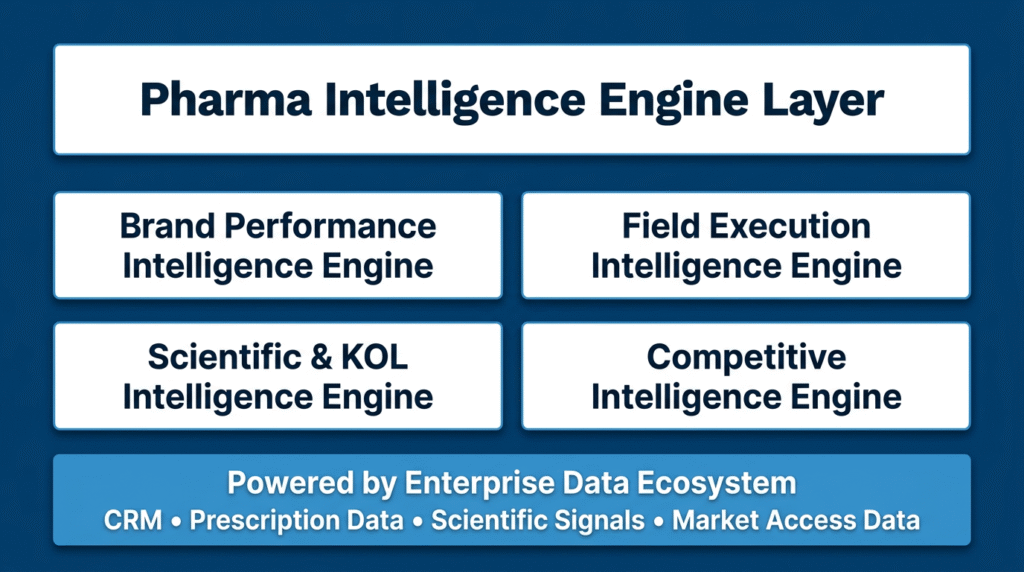
| Intelligence Engine | Same Question Answered | Primary Data Sources | Operational Impact |
| Brand Performance Engine | What is driving brand performance right now? | Prescription data, payer coverage, patient journey signals | Identifies performance drivers and emerging market shifts |
| Field Execution Engine | Where should the field focus next? | CRM engagement data, physician behavior patterns | Prioritizes next-best actions for field teams |
| Scientific & KOL Intelligence Engine | Who is shaping scientific conversation? | Publications, congress activity, trial updates | Guides medical engagement strategy |
| Competitive Intelligence Engine | What has changed in the competitive landscape? | Trial pipelines, regulatory signals, physician sentiment | Enables faster competitive response |
In traditional analytics models, these questions are answered through periodic analyses generated by internal analytics teams or external partners. In an intelligence-engine model, systems continuously monitor enterprise data environments and generate answers dynamically. This shift enables leadership teams to move from episodic reporting toward continuous situational awareness across commercial and medical operations.
Early Signals from Biotech Adoption
Several emerging biotechnology companies are already experimenting with this model. One oncology-focused biotech recently deployed a generative AI layer across its commercial and medical data ecosystem to enable real-time intelligence generation. Rather than replacing existing analytics infrastructure, the system acts as an AI overlay that interprets signals across multiple platforms.
As one commercial leader described the shift:
“Instead of asking our analytics partners to prepare decks for every leadership meeting, we can now ask the system the same questions directly. It sits on top of our existing ecosystem and helps leadership get answers immediately.”
The result is not the elimination of analytics teams, but a change in how intelligence flows through the organization. Teams spend less time preparing slides and more time acting on insights.
The Emerging Execution Layer
For many pharmaceutical organizations, the challenge today is no longer the availability of data or the maturity of analytics infrastructure. Most companies have already built substantial commercial data ecosystems that include CRM platforms, omnichannel engagement systems, and advanced analytics environments. What is often missing is the architectural layer that connects these signals and translates them into decision-ready intelligence for leadership teams.
Increasingly, organizations are introducing AI-driven execution layers that operate across the existing technology stack, synthesizing signals from multiple enterprise systems and generating contextual answers aligned with operational questions. Rather than replacing infrastructure, these systems function as an interpretive layer across the enterprise data environment, enabling commercial and medical leaders to move from periodic analysis toward continuous decision support. The objective of this architectural layer is to enable generative AI execution environments that unify commercial data, CRM systems, and scientific intelligence into a single operational reasoning layer.
From Analytics Infrastructure to Decision Infrastructure
The pharmaceutical industry has already invested heavily in data platforms and analytics environments designed to support commercial operations. The next phase of transformation is therefore less about collecting additional data and more about enabling organizations to interpret the signals they already possess.
Generative AI provides the foundation for this shift. When deployed within a structured intelligence architecture, it enables organizations to move beyond periodic reporting cycles toward systems capable of continuously synthesizing data and generating insights aligned with leadership questions. In increasingly complex therapeutic markets, competitive advantage will depend less on the volume of reporting produced and more on the ability of organizations to generate timely, decision-ready intelligence from the data ecosystems they have already built.
