

Rethinking AI Strategy in Commercial Analytics

Improzo Insights
Perspectives from practitioners in commercial analytics and AI

Executive Summary

Commercial analytics in pharma is shifting from static dashboards and retrospective analysis to actively shaping decisions in near real time. As generative and answer-driven systems surface recommendations directly inside workflows, analytics models built for dashboards and post-hoc analysis show their limits. Organizations seeing real impact are not experimenting with more AI tools, but redesigning how decisions are supported, governed, and executed. A decision-centric approach grounded in clarity of ownership, traceability, and operational adoption is becoming essential for scaling AI in commercial settings.

Rethinking AI Strategy in Commercial Analytics: A Decision-Centric View

Asking whether a pharma organization has an “AI strategy” is increasingly the wrong question. The more useful question is simpler and more operational: which commercial decisions do we want to improve, and why aren’t they working today?

In commercial analytics, AI discussions often gravitate toward tools, models, or platforms. But value is rarely created by technology alone. It comes from better decisions made faster, with clearer context, and with confidence in how they were formed. That distinction matters more as generative and answer-driven systems begin to influence decisions earlier in the commercial workflow.

From explaining outcomes to shaping decisions

Advanced analytics and machine learning have supported commercial teams for years — from targeting and segmentation to forecasting and incentive design. Historically, these systems were designed to explain outcomes. Teams reviewed dashboards, debated insights, and translated findings into action.

Answer-driven systems compress that flow. Recommendations now surface directly inside workflows such as call planning, account strategy, or territory optimization — sometimes before a dashboard is opened.

In one large biotech commercial team, early pilots surfaced recommendations directly in call planning. The models performed well, but adoption stalled when field leaders couldn’t explain why certain HCPs were prioritized over others during review discussions. The models were accurate, but accuracy alone was not enough to earn trust at the point of execution.

This creates opportunity, but it also exposes gaps. Systems built for exploration struggle when asked to support real-time commercial decisions. When recommendations appear closer to execution, teams expect clarity: how the recommendation was formed, what data was used, and what assumptions were applied. Without that visibility, confidence erodes quickly, regardless of the model’s performance.

“AI creates value in commercial analytics only when it improves how decisions are made — not when it simply generates more insight.”

A decision-centric foundation for commercial AI

A practical AI strategy in commercial analytics starts by anchoring on decisions, not use cases.

  1. Define the decision and its owner. Whether the decision involves call planning, targeting, or forecasting, clarity on ownership and success criteria is essential. AI should support decisions already embedded in the business, not create parallel processes.
  2. Prioritize use cases based on value and feasibility. Focus on decisions with clear commercial impact, sufficient data, and realistic adoption paths. Ambiguous outcomes and long time-to-value timelines often derail otherwise strong initiatives.
  3. Measure success operationally. Accuracy alone is not enough. Commercial leaders care about adoption, confidence, cycle-time reduction, and impact on execution. Metrics should reflect how decisions are made and acted upon.

Operating model, governance, and enablers

As AI moves closer to execution, organizational design matters as much as technology.

Successful commercial analytics efforts typically align three roles:

  • Consumers: Brand, sales, and commercial ops leaders who rely on recommendations
  • Translators: Individuals who connect business context with data and analytics
  • Producers: Teams responsible for building and maintaining AI capabilities

Governance plays a similar role. Effective governance is not about slowing innovation; it establishes accountability, clarity, and trust. In commercial settings, the ability to explain how a recommendation was formed often matters more than algorithmic sophistication. None of this works without the right enablers. Data quality, interoperable technology foundations, domain-savvy talent, and selective partnerships determine whether AI becomes embedded or remains experimental.

From experimentation to impact

AI delivers sustained value in commercial analytics only when it improves how decisions are made and executed. That requires discipline: monitoring outcomes, reinforcing adoption, and continually aligning AI initiatives with evolving commercial priorities.

A decision-centric approach reframes AI from a collection of tools into an operating capability. For commercial analytics leaders, that shift — more than any specific technology choice — is what separates experimentation from real impact.

From Decks to Engines: How Generative AI Is Reshaping Pharma Commercial Execution

Over the past decade, pharmaceutical organizations have invested heavily in modernizing their data infrastructure. Commercial ecosystems now include CRM platforms, omnichannel engagement systems, commercial data warehouses, and increasingly sophisticated analytics environments designed to support brand strategy, field execution, and market access planning. Despite these investments, the operational model through which many leadership decisions are made has evolved far less than the technology stack supporting them. In many commercial organizations, analytical turnaround for leadership updates still ranges from several days to multiple weeks.

Before major leadership moments—such as National Sales Meetings (NSMs), Quarterly Business Reviews (QBRs), or strategic brand updates—organizations typically request a familiar set of analyses: brand performance diagnostics, market share trends, field execution summaries, and competitive intelligence updates. Analytics teams and vendor partners assemble datasets, reconcile metrics, generate models, and ultimately produce presentation decks that summarize the latest performance signals.

The analytical rigor behind these deliverables is often strong. However, the process introduces a structural constraint: latency of insight. Markets evolve faster than reporting cycles. Access dynamics shift, competitor narratives change, and HCP behavior adapts continuously. When insight generation depends on manual analytical workflows, organizations often respond only after signals have already matured. Generative AI introduces the possibility of a fundamentally different operating model—one in which commercial organizations rely less on periodic reporting cycles and more on intelligence engines capable of answering operational questions in near real time. The question facing leadership teams is therefore increasingly straightforward: are organizations still producing decks to interpret the past, or are they building systems capable of continuously interpreting the present?

The Rise of Answer Engines in Pharma

Across industries, generative AI is changing how professionals interact with data.

Instead of navigating dashboards or requesting analyses from analytics teams, users increasingly ask direct questions:

  • What changed in prescribing trends this quarter?
  • Which territories are underperforming relative to opportunity?
  • Where are payer restrictions creating access friction?

Modern AI systems can synthesize answers across structured and unstructured datasets and generate contextual explanations aligned with these questions. Within pharmaceutical organizations, this capability enables the emergence of domain-specific answer engines—systems designed to continuously analyze commercial, medical, and engagement data and translate those signals into decision-ready intelligence.

Rather than waiting weeks for analyses to be produced, leadership teams can increasingly interact directly with their enterprise data ecosystem. The underlying signals already exist within CRM systems, prescription datasets, scientific intelligence sources, and payer data environments. What changes is the organization’s ability to interpret those signals dynamically and present them in a form that supports operational decisions.

The Pharma Intelligence Engine Framework

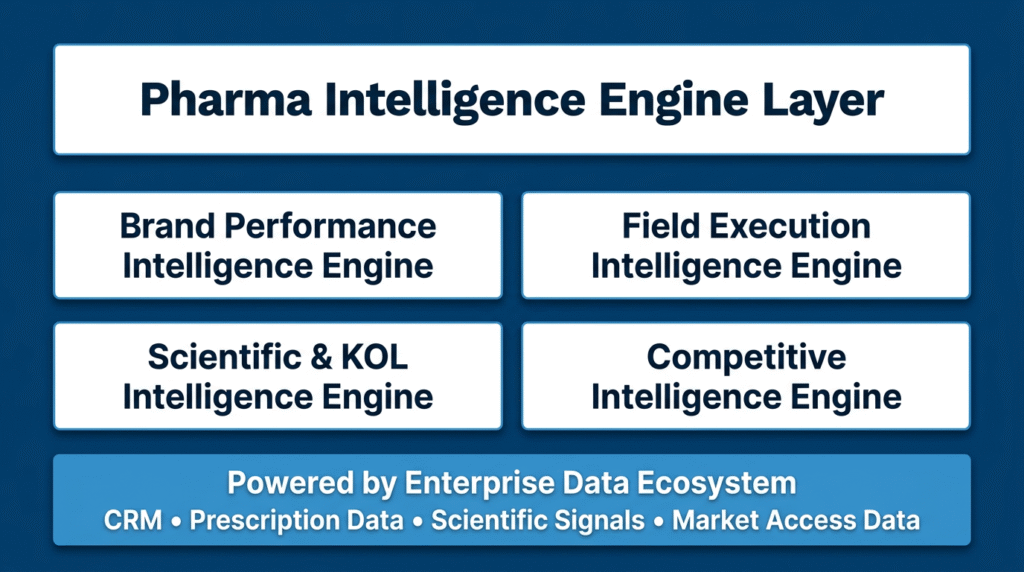
As generative AI adoption accelerates, several intelligence engines are likely to become foundational components of commercial and medical operations in pharma. A practical way to understand this transition is through four intelligence engines that together translate fragmented enterprise data into actionable insights.

Intelligence Engine Same Question Answered Primary Data Sources Operational Impact
Brand Performance Engine What is driving brand performance right now? Prescription data, payer coverage, patient journey signals Identifies performance drivers and emerging market shifts
Field Execution Engine Where should the field focus next? CRM engagement data, physician behavior patterns Prioritizes next-best actions for field teams
Scientific & KOL Intelligence Engine Who is shaping scientific conversation? Publications, congress activity, trial updates Guides medical engagement strategy
Competitive Intelligence Engine What has changed in the competitive landscape? Trial pipelines, regulatory signals, physician sentiment Enables faster competitive response

In traditional analytics models, these questions are answered through periodic analyses generated by internal analytics teams or external partners. In an intelligence-engine model, systems continuously monitor enterprise data environments and generate answers dynamically. This shift enables leadership teams to move from episodic reporting toward continuous situational awareness across commercial and medical operations.

Early Signals from Biotech Adoption

Several emerging biotechnology companies are already experimenting with this model. One oncology-focused biotech recently deployed a generative AI layer across its commercial and medical data ecosystem to enable real-time intelligence generation. Rather than replacing existing analytics infrastructure, the system acts as an AI overlay that interprets signals across multiple platforms.

As one commercial leader described the shift:

“Instead of asking our analytics partners to prepare decks for every leadership meeting, we can now ask the system the same questions directly. It sits on top of our existing ecosystem and helps leadership get answers immediately.”

The result is not the elimination of analytics teams, but a change in how intelligence flows through the organization. Teams spend less time preparing slides and more time acting on insights.

The Emerging Execution Layer

For many pharmaceutical organizations, the challenge today is no longer the availability of data or the maturity of analytics infrastructure. Most companies have already built substantial commercial data ecosystems that include CRM platforms, omnichannel engagement systems, and advanced analytics environments. What is often missing is the architectural layer that connects these signals and translates them into decision-ready intelligence for leadership teams.

Increasingly, organizations are introducing AI-driven execution layers that operate across the existing technology stack, synthesizing signals from multiple enterprise systems and generating contextual answers aligned with operational questions. Rather than replacing infrastructure, these systems function as an interpretive layer across the enterprise data environment, enabling commercial and medical leaders to move from periodic analysis toward continuous decision support. The objective of this architectural layer is to enable generative AI execution environments that unify commercial data, CRM systems, and scientific intelligence into a single operational reasoning layer.

From Analytics Infrastructure to Decision Infrastructure

The pharmaceutical industry has already invested heavily in data platforms and analytics environments designed to support commercial operations. The next phase of transformation is therefore less about collecting additional data and more about enabling organizations to interpret the signals they already possess.

Generative AI provides the foundation for this shift. When deployed within a structured intelligence architecture, it enables organizations to move beyond periodic reporting cycles toward systems capable of continuously synthesizing data and generating insights aligned with leadership questions. In increasingly complex therapeutic markets, competitive advantage will depend less on the volume of reporting produced and more on the ability of organizations to generate timely, decision-ready intelligence from the data ecosystems they have already built.

Smarter Market Access and Launch Execution in the Age of Agentic AI

This perspective reflects observations from working with market access, medical, and commercial teams across multiple launches. It is intended as practical reflection, not product advocacy.

Executive Summary

Pharmaceutical companies have invested heavily in market access strategy, analytics, and evidence generation. Yet, launch outcomes remain uneven. In many cases, the issue is not strategy quality but execution—specifically, the challenge of translating centralized intent into consistent, compliant action across teams and markets. Agentic AI, when applied thoughtfully, offers a practical way to support execution at scale. Rather than introducing new tools or workflows, agentic approaches embed decision support directly into how work gets done, helping organizations respond to change with greater consistency and less friction, particularly during early launch when payer decisions and field responses are most volatile.

Why Strong Access Strategies Still Struggle in Execution

Most launch teams recognize the pattern. A well-designed access strategy is finalized pre-approval. Training is delivered. Materials are approved. Then reality intervenes. Payer decisions arrive in waves. Policies vary by plan and geography. Field teams receive questions they were not trained for, or face scenarios that were not anticipated.

The issue is rarely effort or intent. It is timing and translation. Guidance often reaches the field after decisions are already being made. Updates require new decks, retraining, or system changes. In fast-moving launch environments, this lag has real consequences.

CRM and analytics platforms excel at documenting what happened. They are less effective at supporting what should happen next.

Agentic AI as a Practical Execution Layer

Strategy only matters if it shows up in day-to-day decisions. Agentic AI helps ensure intent is executed consistently when teams are under real operational pressure.

In this context, agentic AI refers to systems that interpret context and act within approved boundaries, rather than simply generating insights or answers. Agentic AI shifts the focus from reporting to execution support. Instead of relying on static playbooks, agentic systems interpret context—who the user is, what has changed, and what is approved—and surface relevant guidance within existing workflows.

This does not remove human judgment. It narrows the gap between intent and action. When a payer policy changes mid-launch, the challenge is not discovering the update. It is ensuring that teams interpret and respond to it consistently. Agentic systems help translate change into role-specific, compliant recommendations without forcing teams to stop and reorient.

Used well, agents reduce variability. Used poorly, they add noise. Design discipline matters.

Where Agentic Approaches Create Real, Observable Value

In practice, agentic execution support tends to matter most in a small number of execution-heavy areas:

  • Field-facing translation of access strategy
    Teams receive guidance in context—aligned to geography, role, and timing—rather than relying on memory, manuals, or post hoc clarification.
  • Early-launch adaptation
    As coverage decisions and utilization management criteria emerge, execution adjusts without waiting for formal retraining cycles.
  • Consistency under pressure
    When teams are stretched, embedded guidance reduces reliance on individual interpretation and informal workarounds.
  • Structured feedback to strategy teams
    Signals from execution are captured in usable form, enabling faster refinement of access strategy.

Individually, these gains are incremental. Together, they reduce avoidable friction during the most sensitive phase of a launch. The value shows up less in breakthroughs and more in everyday execution.

Designing for Regulated Reality

Agentic systems in life sciences must be constrained, auditable, and aligned to approved content. The goal is not speed alone, but reliability. Platforms that treat agents as an execution layer—rather than a replacement for existing systems—tend to integrate more cleanly and age better over time.

Voice and Data-Native Interaction Without Workflow Disruption

Execution support only works if it fits naturally into daily work. Voice-enabled interaction is increasingly relevant—not as a novelty, but as a practical interface. It allows teams to capture insights or ask context-aware questions without breaking flow, particularly in field-based roles.

Equally important is where agentic reasoning occurs. Operating directly on governed enterprise data platforms, such as Snowflake, ensures guidance reflects current, permissioned data without duplication or reconciliation. In regulated environments, trust in the underlying data is non-negotiable.

The combination is subtle but important: natural interaction on top, disciplined data foundations underneath.

A More Resilient Model for Launch Execution

Market access will always involve uncertainty. What organizations can control is how they respond as conditions change. Agentic AI, applied with restraint, offers a way to close the gap between strategy and execution without adding operational burden. The result is not perfect foresight, but fewer preventable missteps when it matters most. A model with the flexibility to incorporate new technology in service of decision-making can materially reduce friction and leakage in market access.

From Improzo

From Improzo’s perspective, agentic execution represents a natural evolution of how life sciences teams operationalize strategy—embedded within existing systems, grounded in enterprise data, and designed to support compliant action at scale. The emphasis is not on replacing teams or platforms, but on reducing friction between intent and execution across commercial and medical operations.

Agentic AI in Pharma Commercial & Medical: A Practical FAQ on Scaling Governed Execution in Life Sciences

Why We Created This FAQ

Over the past year, we’ve had repeated, candid conversations with commercial, medical, analytics, and operations teams across large pharma and growth-stage biotech organizations. While the contexts varied, the questions were strikingly consistent.

Teams weren’t asking what agentic AI is. They were asking why pilots weren’t sticking, why recommendations were hard to trust, and why automation sometimes created more reviews and escalations instead of fewer. In many cases, the technology worked—but the workflows, governance, and decision context did not.

What became clear is that most writing on agentic AI in life sciences is either too abstract or too tool-centric. It focuses on models or autonomy, while the real friction sits in execution: how decisions are made, reviewed, escalated, and learned from across commercial and medical workflows.

We created this FAQ to reflect those real conversations. It is grounded in operating reality, shaped by how agentic workflows are being deployed today, and aligned to Improzo’s execution-first philosophy.


1) What does “agentic AI” actually mean in pharma commercial and medical operations?

In life sciences, agentic AI is best understood as governed execution, not content generation or analytics augmentation. One way we talk about this is using the term “Intelligent Automation,” IA, instead of artificial intelligence. It’s about where to automate and why, rather than an artificial intelligence or agentic solution alone.

An agentic system gathers context across CRM, engagement data, third-party sources, content, and policies; applies commercial, medical, and compliance logic before acting; recommends or executes actions within defined boundaries; and records why decisions were made, not just what happened.

Improzo’s iZO framework is designed around this reality—focusing on execution-time context, governed action, and decision traceability rather than standalone agents or chat-based copilots.


2) Where does agentic AI make a meaningful impact in day-to-day pharma execution?

Agentic AI delivers the greatest impact where teams already spend significant time coordinating decisions rather than making them. These are workflows that repeat frequently, span multiple systems, and involve exceptions.

In commercial and medical operations, this commonly includes:

  • Field enablement and next-best-action workflows that require contextual rationale
  • Targeting and segmentation refresh cycles with evolving definitions
  • Medical inquiry intake, evidence assembly, and escalation
  • Master data and identity resolution across vendors and systems
  • Research in regulatory, legal, or compliance policies and trends and their implications
  • Expense reporting policy compliance checking

For example, in a large U.S. biopharma commercial organization, iZO agents are used to refresh targeting recommendations weekly by synthesizing CRM activity, third-party data, and prior exception logic. Edge cases are routed for human review, while standard changes flow through automatically, reducing cycle time from days to hours with a clear audit trail for every change. This is not about removing all human interaction; it’s about focusing it where it makes the most valuable impact.


3) What does it take to have “agent-ready data” in regulated life sciences?

Agent-ready data does not mean perfect data quality. It means decision-grade readiness—data that can support action and withstand scrutiny.

In regulated environments, this typically requires:

  • Clear semantic definitions for core entities such as HCPs, HCOs, accounts, interactions, and indications
  • Reliable identity resolution across internal and external data sources
  • Version controls and governance around data that is published as part of an ETL process and the AI software used in the solution
  • Temporal context to reconstruct what was known at the time a decision was made
  • Explicit rules governing how data may be used by function, role, and geography

Without these foundations, agentic systems often produce plausible outputs that teams hesitate to act on—slowing execution rather than accelerating it.


4) How should life sciences organizations select initial agentic AI use cases?

Successful programs begin with bounded, execution-focused workflows, not broad transformations.

Strong early use cases typically:

  • End in a clear operational action with defined success criteria
  • Operate within known commercial and medical constraints
  • Occur frequently enough for learning and value to compound
  • Can be brought to a minimum viable product (MVP) solution within a reasonable timeframe (usually less than 6 months)
  • Has a visible, painful problem that is unmet with current solutions

Many organizations start with a combination of commercial execution, medical operations, and data stewardship workflows, allowing teams to prove value while building confidence in governance and control. Another critical component is the visibility to key stakeholders of the need for improvement, and a reasonable timeline to determine success and gain traction for expanding the use case to other areas.


5) How does governance work for agentic AI in pharma?

In life sciences, governance must be embedded directly into execution, not applied after the fact.

Effective agentic governance clearly defines:

  • Which actions agents may execute autonomously versus recommend
  • When human review or approval is required
  • How exceptions, overrides, and rationale are captured

iZO agents enforce these rules before actions occur, ensuring compliance is proactive rather than reactive and reducing informal decision-making that often lives outside systems.


6) What does it take to scale agentic AI beyond pilots in pharma?

Scalability is achieved through orchestrated, modular workflows, not single monolithic agents. This mirrors how regulated work already happens across commercial and medical teams.

A scalable agentic setup typically includes:

  • Context retrieval across data sources
    Relevant signals are gathered from CRM systems, engagement platforms, data vendors, content repositories, and prior decisions—while enforcing access controls and data usage policies.
  • Business and compliance rule evaluation
    Brand rules, medical constraints, regional policies, and role-based permissions are evaluated upfront to determine whether an action is allowed, modified, or escalated.
  • Action recommendation or execution
    Based on validated context and rules, the agent proposes or executes approved actions with a clear rationale, so users understand both the recommendation and its basis.
  • Decision logging and traceability
    Each action is recorded with supporting data, applied rules, approvals, and outcomes—creating a durable record for auditability, review, and learning.

This execution-first architecture is core to iZO and enables safe, incremental scaling.


7) How is explainability maintained without slowing execution?

Explainability in pharma is about decision context, not exposing model internals. Teams need to understand why action was taken to trust it, defend it, and improve it.

Well-designed agentic systems consistently surface:

  • The key data signals that influenced the decision
  • The commercial, medical, or compliance rules that were applied
  • The reason an action was taken, modified, or escalated

When this context is standardized, execution accelerates. Teams spend less time reconstructing decisions and more time acting with confidence.


8) What signals show real progress toward agentic maturity?

Agentic maturity is reflected in operational outcomes, not novelty.

Meaningful indicators include reduced cycle time in commercial and medical workflows, sustained adoption beyond pilot phases, clear and explainable override patterns, and an increasing percentage of actions with complete audit trails.

Override patterns are especially valuable. They highlight where definitions, rules, or data require refinement, turning human judgment into a learning signal rather than friction, and focusing human time and energy on only the edge cases rather than the most common flow with the highest volume.


9) Why do many agentic AI initiatives stall—and how can it be avoided?

Most challenges are organizational rather than technical. Agentic systems often expose ambiguity that already existed but was previously hidden in manual processes. It also exposes gaps in institutional memory, often propagated by a lack of documentation in processes.

Common pitfalls include unclear ownership of definitions, attempting to scale too many workflows simultaneously, and treating agents as standalone tools rather than embedded execution capabilities. Organizations that succeed in a narrow scope early, assign clear accountability, and evolve workflows incrementally will be able to avoid many of the pitfalls of agentic AI implementation.


10) How does agentic AI adoption unfold over time?

Agentic AI adoption is a progression, not a switch.

  • Early phases focus on assisted decision-making with human oversight and well-defined criteria
  • Mid phases automate routine steps while surfacing exceptions more intelligently.
  • Later phases standardize how decisions are executed and learned from across commercial and medical functions.

The outcome is faster, more consistent execution with transparency and control, not unchecked autonomy. A biproduct is often much clearer decision criteria, documentation of process and operating models for these areas of adoption of AI.

Final Perspective

Agentic AI is not about replacing human judgment. It is about making judgment explicit, governable, and scalable through governed AI execution in life sciences and focusing human energy where it is most impactful.

Improzo’s iZO framework is built to operate intelligence where it matters most, inside real commercial and medical workflows, grounded in context, governed by design, and focused on execution rather than experimentation.

Gen AI-Enhanced Personalized and Intelligent Analytics

In today’s pharmaceutical environment, executive and commercial leaders face increasing pressures—accelerated product launches, heightened competitive dynamics, stringent compliance requirements, and the critical need to convert vast volumes of data into actionable business intelligence. Conventional dashboards and manual reporting no longer suffice to navigate the speed and complexity of commercial operations. By harnessing advanced AI-driven insights, pharma executives can act swiftly and confidently with proactive, relevant, and easily accessible intelligence designed to drive meaningful commercial outcomes.

AI-Enhanced Analytics: A Game Changer for Pharma Leadership

Anticipating and responding to shifts—whether in market dynamics, product adoption, physician engagement, or patient adherence—before they impact revenue or reputation is essential for pharma boards and commercial leadership. The iZO insights and analytics platform, built upon the latest AI-powered features from advanced data visualization and analytics technologies, empowers organizations with timely, actionable, and context-rich insights engineered to inform high-stakes commercial decisions.

Real-time awareness: Stay on top of sales performance, account health, and launch excellence as they unfold.

Deeper understanding: Instantly grasp why KPIs shift—not just what changed—enabling root-cause analysis and alignment.

Action in the flow of business: Embedded alerts and insights drive frontline decisions, supporting teams both in the field and in the boardroom.

Addressing Limitations of Traditional Solutions

Legacy analytics approaches rely heavily on static dashboards, manual reporting, and a heavy dependence on analytics teams, which present several challenges including:

Static and after-the-fact insights: Traditional dashboards require constant manual monitoring and often deliver insights too late to act effectively.

Information overload: Vast datasets without clear prioritization overwhelm users, making it difficult to focus on what truly matters.

Analytics bottlenecks: Heavy reliance on analytics teams slows down the speed of insight generation and decision-making.

iZO addresses these challenges by seamlessly integrating AI-powered alerting, natural language querying, and scenario modeling—leveraging advanced technologies inspired by Tableau Pulse and Agent—to deliver analytics that are dynamic, accessible, and precisely aligned with evolving business needs

Key Use Cases for Commercial and Executive Leaders

  1. Product Launch Excellence

Challenge: New product launches are highly complex, with critical early signals often buried within sales, distribution, healthcare provider (HCP) engagement, and market access data.

How iZO Helps:

iZO continuously monitors launch KPIs—such as uptake, prescription trends, and formulary changes—and delivers real-time alerts when performance deviates from plan. Advanced AI-driven querying allows leadership to instantly explore market dynamics, asking questions like “What markets saw the largest spike in competitor share this week?” This proactive detection enables early intervention, recalibrating strategy and resources to optimize launch success.

  1. Sales Force Effectiveness

Challenge: Maximizing sales impact requires up-to-date insights on representative performance, physician engagement, and message recall to feed agile coaching and resource allocation.

How iZO Helps:

The platform delivers automated, role-specific notifications directly into collaboration workflows when key metrics dip or fall below thresholds. Conversational AI capabilities enable leaders to investigate sales performance dynamically, for example, “Show me top-performing reps by region and their key activities last quarter.” This fosters alignment across leadership, sales operations, and field teams, eliminating reliance on slow monthly reports.

  1. Market Access & Pricing Response

Challenge: Rapid shifts in payer formularies, competitive pricing, and regional reimbursement require swift, informed action to protect or grow market share.

How iZO Helps:

iZO tracks reimbursement trends and flags unexpected coverage or pricing changes that could threaten revenue. Scenario analysis tools empower executives to explore “what-if” scenarios efficiently, such as estimating the impact of a 10% Medicaid coverage drop in a region. This synthesis of complex data into actionable intelligence supports confident, timely market responses.

  1. Executive Reporting & Board Readiness

Challenge: Executive and board meetings demand not just numbers but contextualized understanding and insights answering “why” and “what’s next.”

How iZO Helps:

The platform auto-generates narrative highlights and causal summaries ahead of reviews, providing clear, plain-language insights. Embedded interactive exploration enables decision-makers to drill into root causes on demand, removing the need for extensive analyst preparation and accelerating data-driven governance conversations.

Why These Features Matter for Pharma Executives

Impact Area Legacy Approach iZO Advantage
Decision Speed Slow, after-the-fact Proactive, real-time alerts and causal insights
Data Accessibility Analysts as gatekeepers Executive-friendly, self-serve natural language interactions
Actionability Manual follow-up required Embedded insights within collaboration and CRM tools
Trust & Governance Ad hoc, inconsistent Certified, governed metrics ensuring compliance

Unlocking Leadership Advantages

Predict Emerging Risks: Detect underperforming accounts, formulary losses, or demand shifts early to prevent widespread issues.

Optimize Resource Allocation: Rapidly deploy sales, marketing, and access resources focused on high-impact regions and accounts.

Enhance Team Agility: Empower commercial teams and affiliates with trusted, instant insights—aligning sales, medical, and market access functions.

Support Strategic Growth: Equip C-suite and board leaders with narrative-rich, actionable intelligence that drives better launch, portfolio, and pricing decisions.

Taking the Next Step

For commercial and executive leaders in pharma, iZO represents a paradigm shift: analytics is no longer just a rearview mirror but a strategic co-pilot enabling forward-looking action. By incorporating the latest AI-powered alerting, natural language querying, and scenario modeling capabilities drawn from industry-leading innovations, iZO transforms how leaders anticipate, respond, and outperform—fueling commercial success and advancing patient care.

Ready to empower your leadership to see further, act faster, and lead smarter? Explore how iZO and its AI-enhanced analytics can elevate your organization’s commercial impact.


Boosting Sales Force Effectiveness in Pharmaceuticals: Harnessing the Power of Generative AI

In the competitive pharmaceutical landscape, enhancing sales force effectiveness is essential for driving commercial success. Generative AI (Gen AI) emerges as a transformative technology that redefines established methodologies, offering innovative solutions to elevate various facets of sales operations. This blog explores how generative AI solutions are differentiated from current approaches, focusing on sales force sizing and placement, customer targeting, territory optimization, call planning, performance measurement, and incentive compensation.

1. Sales Force Sizing and Placement

Current methods for sales force sizing rely heavily on static models, historical averages, or analog-based benchmarks. These approaches often use historical revenue data or workload analysis to determine the number of representatives required in each territory. While these methods provide a starting point, they lack adaptability to real-time market changes or variations in HCP behavior. For example:

Static Revenue Models: Assign resources based on past sales performance without accounting for emerging markets or shifts in demand.

Workload Analysis: Estimates representative needs based on call frequencies and engagement time but fails to incorporate dynamic factors like HCP responsiveness or competitive activity.

Generative AI Advantage:

With Generative AI, it is possible to integrate diverse datasets-historical sales data, market potential, and real-time HCP engagement metrics-to recommend optimal sales force sizes and placements dynamically. Unlike static models, Gen AI based solutions can adapt to changing market conditions by:

  • Continuously analysing demand fluctuations and prescribing patterns.
  • Efficiently simulating multiple scenarios to optimize resource allocation.
  • Preventing over-resourcing in low-potential areas while ensuring adequate coverage in high-growth regions.

2. Targeting the right customers effectively

Traditional customer targeting uses broad segmentation approaches based on limited criteria such as geography, specialty, or prescribing volume. These strategies often fail to capture the nuances of individual HCP preferences or behaviours:

One-Size-Fits-All Segmentation: Treats all HCPs within a segment similarly, missing opportunities for personalized engagement.

Reactive Targeting: Relies on past prescribing data without proactively identifying high-potential customers.

Generative AI Advantage:

Gen AI can enable hyper-personalized targeting by analysing more extensive datasets, including not just prescribing patterns but also digital engagement behaviors, and demographic details.It can help achieve:

  • Predictive Segmentation: Identifying high-potential HCPs likely to respond positively to outreach.
  • Tailored Engagement Plans: Generates specific recommendations for discussion topics, preferred communication channels, and timing-ensuring every interaction is relevant and impactful.

3. Optimizing Territory Alignments

Existing territory design and optimization methodologies are not dynamic enough to effectively adapt to shifts in market dynamics. They also rarely take into consideration inputs such as HCP engagement preferences and access restrictions while identifying total workload.

  • Static Alignments: Territories are rarely reassessed unless triggered by major restructuring.
  • Inefficient Workload Distribution: Leads to overburdened representatives in high-demand areas while underutilizing others in low-demand regions.

Generative AI Advantage:

Gen AI based solutions can help continuously optimize territories by analysing real-time geographic and demographic data alongside market potential. It can ensure:

  • Balanced workloads across representatives at all times.
  • Dynamic adjustments based on HCP engagement trends or competitive activity.
  • Improved coverage of high-priority areas without overextending resources.

4. Streamlining Call Planning

Call planning is often manual or rule-based, relying on rigid frequency targets (e.g., X calls per month per HCP). This approach lacks flexibility and fails to account for individual HCP preferences or availability:

  • Frequency-Based Planning: Focuses on quantity over quality of interactions.
  • Generic messaging: Representatives often approach calls with standard scripts that may not address specific HCP needs.

Generative AI Advantage:

Gen AI can help transform call planning by leveraging historical engagement data and real-time insights:

  • Intelligent Call Scheduling: Recommends optimal call times based on HCP availability and responsiveness patterns.
  • Customized Agendas: Tailors each interaction with relevant product information and discussion points aligned with the HCP’s preferences-fostering deeper connections.

5. Measuring Sales Force Performance

Performance measurement traditionally relies on retrospective metrics such as quarterly sales reports or call activity logs. These lagging indicators provide limited visibility into ongoing trends or emerging issues. Typical challenges faced while measuring performance are:

  • Delayed Insights: Reactive reporting often results in missed opportunities for timely interventions.
  • Narrow Metrics Focus: Emphasizes quantitative KPIs like call volume over qualitative factors like engagement quality.

Generative AI Advantage:

With Gen AI, performance measurement can be enhanced with real-time analytics and predictive modelling:

  • Dynamic Dashboards: Provide real time insights into KPIs such as conversion rates, territory performance, and customer satisfaction.
  • Proactive Interventions: Predictive analytics can identify potential issues early, enabling timely course corrections that improve overall productivity.

6. Enhancing Incentive Compensation Strategies

Established Approaches:

Incentive structures are often based on historical performance metrics without accounting for evolving market conditions or individual preferences:

  • Fixed Compensation Models: There is lack flexibility and personalization in incentive plans with a single plan structure applied to all field force personnels
  • Delayed insights: Sales teams often get delayed insights into their performance, preventing them to take corrective action in time.

Generative AI Advantage:

Gen AI revolutionizes incentive compensation by simulating multiple scenarios using real-time data:

  • Personalized Compensation Plans: With Generative AI, it will be possible to analyse behavioural data to understand motivational drivers of the field and appropriately design IC options to choose from, thus making them more personalized
  • Real time insights and Field Support: Generative AI will enable real time and predictive insights powered by historical data, market trends and customer preferences. This will better equip the field force to gauge the impact of their activity and ensure a successful sales cycle.

Conclusion

Generative AI represents a paradigm shift from traditional methodologies in enhancing sales force effectiveness within the pharmaceutical industry. By addressing the limitations of static models, broad segmentation strategies, and reactive reporting systems, Gen AI introduces precision, adaptability, and scalability into every aspect of sales operations. As we advance further into 2025 and beyond, leveraging generative AI will be critical for maintaining a competitive edge in an increasingly complex marketplace. By integrating real-time data analytics, predictive insights, and personalized engagement strategies at scale, pharmaceutical companies can unlock new levels of efficiency and effectiveness-ultimately driving better outcomes for their organizations and the healthcare providers they serve.