
Smarter Market Access and Launch Execution in the Age of Agentic AI

This perspective reflects observations from working with market access, medical, and commercial teams across multiple launches. It is intended as practical reflection, not product advocacy.

Executive Summary

Pharmaceutical companies have invested heavily in market access strategy, analytics, and evidence generation. Yet, launch outcomes remain uneven. In many cases, the issue is not strategy quality but execution—specifically, the challenge of translating centralized intent into consistent, compliant action across teams and markets. Agentic AI, when applied thoughtfully, offers a practical way to support execution at scale. Rather than introducing new tools or workflows, agentic approaches embed decision support directly into how work gets done, helping organizations respond to change with greater consistency and less friction, particularly during early launch when payer decisions and field responses are most volatile.

Why Strong Access Strategies Still Struggle in Execution

Most launch teams recognize the pattern. A well-designed access strategy is finalized pre-approval. Training is delivered. Materials are approved. Then reality intervenes. Payer decisions arrive in waves. Policies vary by plan and geography. Field teams receive questions they were not trained for, or face scenarios that were not anticipated.

The issue is rarely effort or intent. It is timing and translation. Guidance often reaches the field after decisions are already being made. Updates require new decks, retraining, or system changes. In fast-moving launch environments, this lag has real consequences.

CRM and analytics platforms excel at documenting what happened. They are less effective at supporting what should happen next.

Agentic AI as a Practical Execution Layer

Strategy only matters if it shows up in day-to-day decisions. Agentic AI helps ensure intent is executed consistently when teams are under real operational pressure.

In this context, agentic AI refers to systems that interpret context and act within approved boundaries, rather than simply generating insights or answers. Agentic AI shifts the focus from reporting to execution support. Instead of relying on static playbooks, agentic systems interpret context—who the user is, what has changed, and what is approved—and surface relevant guidance within existing workflows.

This does not remove human judgment. It narrows the gap between intent and action. When a payer policy changes mid-launch, the challenge is not discovering the update. It is ensuring that teams interpret and respond to it consistently. Agentic systems help translate change into role-specific, compliant recommendations without forcing teams to stop and reorient.

Used well, agents reduce variability. Used poorly, they add noise. Design discipline matters.

Where Agentic Approaches Create Real, Observable Value

In practice, agentic execution support tends to matter most in a small number of execution-heavy areas:

  • Field-facing translation of access strategy
    Teams receive guidance in context—aligned to geography, role, and timing—rather than relying on memory, manuals, or post hoc clarification.
  • Early-launch adaptation
    As coverage decisions and utilization management criteria emerge, execution adjusts without waiting for formal retraining cycles.
  • Consistency under pressure
    When teams are stretched, embedded guidance reduces reliance on individual interpretation and informal workarounds.
  • Structured feedback to strategy teams
    Signals from execution are captured in usable form, enabling faster refinement of access strategy.

Individually, these gains are incremental. Together, they reduce avoidable friction during the most sensitive phase of a launch. The value shows up less in breakthroughs and more in everyday execution.

Designing for Regulated Reality

Agentic systems in life sciences must be constrained, auditable, and aligned to approved content. The goal is not speed alone, but reliability. Platforms that treat agents as an execution layer—rather than a replacement for existing systems—tend to integrate more cleanly and age better over time.

Voice and Data-Native Interaction Without Workflow Disruption

Execution support only works if it fits naturally into daily work. Voice-enabled interaction is increasingly relevant—not as a novelty, but as a practical interface. It allows teams to capture insights or ask context-aware questions without breaking flow, particularly in field-based roles.

Equally important is where agentic reasoning occurs. Operating directly on governed enterprise data platforms, such as Snowflake, ensures guidance reflects current, permissioned data without duplication or reconciliation. In regulated environments, trust in the underlying data is non-negotiable.

The combination is subtle but important: natural interaction on top, disciplined data foundations underneath.

A More Resilient Model for Launch Execution

Market access will always involve uncertainty. What organizations can control is how they respond as conditions change. Agentic AI, applied with restraint, offers a way to close the gap between strategy and execution without adding operational burden. The result is not perfect foresight, but fewer preventable missteps when it matters most. A model with the flexibility to incorporate new technology in service of decision-making can materially reduce friction and leakage in market access.

From Improzo

From Improzo’s perspective, agentic execution represents a natural evolution of how life sciences teams operationalize strategy—embedded within existing systems, grounded in enterprise data, and designed to support compliant action at scale. The emphasis is not on replacing teams or platforms, but on reducing friction between intent and execution across commercial and medical operations.


Execution-Native AI for Qualitative Market Research

Making Human Insight Reusable Without Replacing Human Judgment

Executive Summary

Qualitative market research remains one of the earliest and most valuable sources of signal in biopharma. Advisory boards, interviews, and field feedback often surface shifts in access, sentiment, and unmet need well before they appear in quantitative data.

Yet much of this insight remains difficult to reuse. Findings live in decks and documents, summarized differently across teams and projects. When similar questions arise later, research is often repeated. The friction is not in generating insight — it is in finding, comparing, and reusing it reliably.

AI is not replacing qualitative research or human interpretation. Its most effective role is operational. Execution-native AI embeds intelligence into the research workflow after data collection. Instead of generating conclusions, it structures qualitative inputs consistently, links insights to evidence, and makes prior research discoverable across brands, markets, and time. Researchers continue to define hypotheses and interpret meaning. AI reduces administrative effort and preserves institutional memory. The result is insight that travels further and lasts longer.

Building an Execution-Native Foundation

Organizations that scale AI in qualitative research embed it directly into the research lifecycle, focusing on consistency, traceability, and reuse.

Core Architectural Components

  • Ingestion of interviews, open-ended responses, field notes, and research archives
  • Automated structuring of unstructured data while preserving context
  • Alignment to existing governed taxonomies across studies
  • Evidence-linked insights traceable to source excerpts
  • Integration with analytics and knowledge systems

This approach turns qualitative research from static output into cumulative enterprise intelligence.

Governance Mechanisms

Governance ensures AI improves consistency and reuse in qualitative research without compromising rigor, accountability, or compliance. Defined model boundaries, evidence traceability, and human oversight ensure insights remain reliable, auditable, and appropriate for both commercial decision-making and medical review processes.

  • Bounded model roles: AI is constrained to specific tasks such as classification or extraction, improving consistency while reducing risk.
  • Human-in-the-loop review: Researchers retain control over high-impact insights and final interpretation.
  • Source traceability and auditability: All synthesized insights remain directly linked to original evidence and study context.
  • Access controls and compliance: Role-based controls ensure sensitive insights are reused securely and in line with regulatory requirements.

From Field Insight to Action

As AI-driven search becomes a primary discovery layer, qualitative insights must be machine-interpretable. Clear, declarative language, direct answers to real questions, and explicit links to supporting evidence allow both humans and AI systems to retrieve and cite insights accurately. In biopharma commercial teams, early signals often emerge through advisory boards and sales feedback, where access barriers, payer dynamics, or shifts in competitor messaging surface first in qualitative conversations.

Execution-native AI structures these insights at ingestion using consistent commercial taxonomies—such as access friction, message resonance, and unmet need—while preserving verbatim context. When teams ask questions like “What access objections are emerging post-launch?”, they can retrieve and compare prior insights across brands and markets without manual re-analysis, enabling faster alignment and better decisions without replacing commercial judgment.

Final Perspective

The future of qualitative market research is not automation of insight. It is execution excellence.

AI should reduce friction, preserve context, and make insight reusable — while leaving interpretation firmly in human hands. When designed correctly, AI does not diminish qualitative research. It allows it to scale.

What If Every Patient Had an AI Advocate?

A Commercial Life Sciences View on Intelligent Engagement

“Voice will become the most natural interface for healthcare engagement — not because it is novel, but because it removes friction from complex systems. When intelligence meets everyday conversation, execution finally scales.” — Inderpreet Kambo, Cofounder & CEO, Improzo

Life sciences organizations have invested heavily in modern data foundations and engagement infrastructures. Snowflake-powered platforms now aggregate patient, provider, and real-world data at scale. CRM systems orchestrate field activity and omnichannel touchpoints. Advanced analytics surface patterns, segments, and adoption barriers with increasing sophistication.

Yet despite this progress, a familiar challenge persists, translating insight into consistent, real-time execution that meaningfully improves patient and provider journeys. In many organizations, CRM still functions primarily as a system of record, while analytics remains a retrospective layer. Insights are generated centrally and reviewed periodically but often sit outside the flow of daily work. This creates fragmented engagement, delayed responses, and inconsistent experiences across channels. As therapies become more complex and patient expectations continue to rise, insight alone is no longer enough. The real differentiator is how effectively organizations operate intelligence in real time.

The emerging concept of an AI advocate represents a shift from insight production to intelligent orchestration embedded directly into engagement workflows.

Moving from Insight to Intelligent, Voice-Enabled Engagement

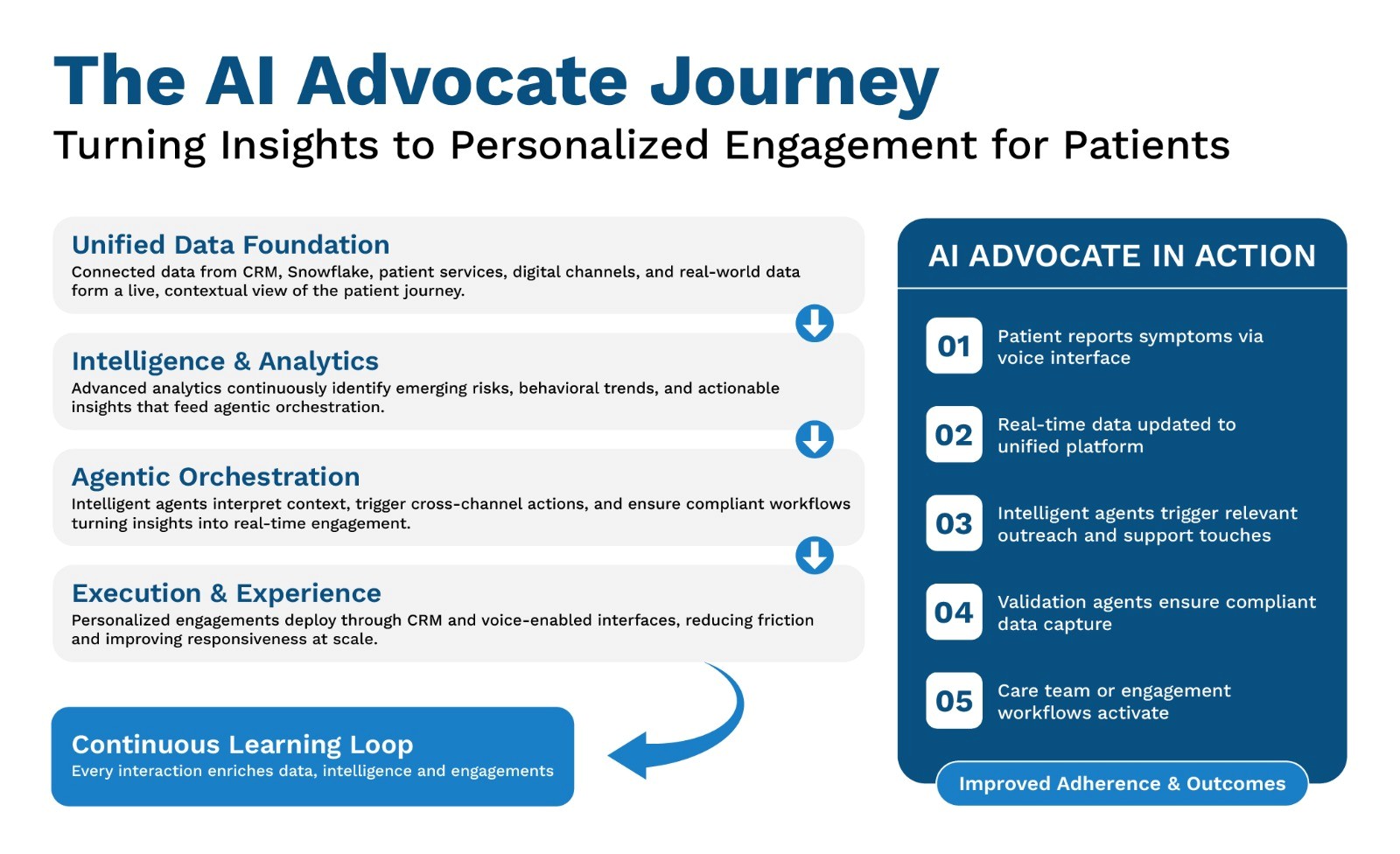
Rather than producing periodic recommendations or static next-best-action reports, the AI advocate model leverages agentic AI to continuously monitor real-time data across Snowflake, CRM platforms, digital channels, and patient services. Intelligent agents interpret context, identify emerging barriers, and orchestrate actions automatically as journeys unfold.

Voice-enabled interfaces further remove friction from engagement. Patients, support teams, and field representatives can interact naturally with systems that understand context and trigger workflows instantly. This transforms engagement into a responsive ecosystem — one that adapts as patient needs change, rather than reacting after issues surface.

In practice, AI advocates enable commercial operators to:

  • Orchestrate real-time next-best actions across channels, triggering personalized outreach, education, and support workflows as patient and provider signals evolve.
  • Embed compliance and data quality directly into execution, using validation agents to ensure interactions meet regulatory standards while strengthening downstream analytics.
  • Unify fragmented touchpoints into a continuous journey view, connecting CRM activity, patient services, digital engagement, and real-world data in real time.
  • Scale personalization without operational complexity, delivering millions of individualized experiences consistently through automated, intelligent workflows.

Connecting Commercial Execution and Patient Journeys

Engagement in life sciences spans commercial teams, medical affairs, patient services, and digital platforms — often operating in parallel with limited coordination. This fragmentation leads to handoffs, delays, and inconsistent experiences for both patients and providers.

Agentic AI advocates act as an orchestration layer across this ecosystem. By maintaining a longitudinal, real-time view of each journey, intelligent agents align actions across functions and systems. Rather than relying on static reports or manual coordination, orchestration happens dynamically as events occur.

This enables organizations to focus on addressing real barriers — whether access challenges, therapy management complexity, or engagement gaps — while analytics continuously optimize strategies in real time.

The framework visually illustrates how unified data feeds intelligence, how agentic orchestration connects insight to execution, and how CRM and voice-enabled engagement deliver real-time experiences — all reinforced through continuous learning. For operators, the outcome is faster response, clearer accountability, and measurably improved engagement effectiveness across the lifecycle.

The Improzo Perspective: From Insight to Real-Time Action

At Improzo, we believe the next phase of commercial transformation is not about adding more tools or generating more insights. It is about turning existing platforms — Snowflake, CRM, analytics,  into systems of real-time action.

  • Agentic AI becomes the connective layer between intelligence and execution. Engagement agents drive personalized actions across channels. Validation agents ensure trust, compliance, and data integrity. Orchestration agents coordinate workflows across commercial, medical, and patient services.
  • Voice-enabled engagement removes friction at the experience layer, making interaction more natural while capturing richer context in real time.

Together, these capabilities close the long-standing gap between analytics and execution. For patients, this creates seamless, proactive, and personalized journeys. For commercial leaders, it delivers measurable improvements in efficiency, engagement performance, and outcomes. The next era of life sciences engagement will not be defined by better insights alone, but by how effectively organizations operate in real time, for every journey.