

Q&A: Redefining Market Intelligence in Life Sciences— From Static Reports to Predictive, Decision-Grade Platforms
A conversation with Jane Urban, Chief Data & Analytics Officer at Improzo, Oct 20, 2025
Q1: Jane, you’ve worked across multiple life sciences organizations leading analytics and transformation initiatives. How has market intelligence traditionally been approached in animal health?
Jane: For most of my career, market intelligence has been built around periodic reporting cycles. Teams pull data from third-party sources, blend it with internal sales data, and deliver monthly or quarterly spreadsheets and slide decks.
That model worked when channels were simpler and decisions moved more slowly. But today—with this dynamic increasingly visible in animal health—growth is happening across e-commerce, mass retail, specialty distributors, and evolving care models. Market dynamics can shift week to week, yet many leaders are still making decisions based on information that’s several weeks old. That gap between market reality and reporting is where opportunity is lost.
Q2: What are the biggest challenges companies face when relying on traditional retail and market research reports today?
Jane: There are four challenges I see consistently across life sciences organizations, including in animal health:
Flattened data structures
Performance across channels, geographies, species, and products is collapsed into high-level summaries, masking early signals and localized shifts.
Lagging insights
By the time reports are delivered—often four to six weeks after activity—the opportunity to course-correct pricing, promotion, or field focus has already passed.
Limited precision transparency
Forecasts are presented as single numbers or narrow ranges, without visibility into confidence, sensitivity, or underlying assumptions—making it difficult to act decisively.
Siloed data sources
Retail, distributor, internal sales, e-commerce, and market research data live in separate systems, preventing a truly unified view of demand and performance.
Q3: You often talk about the need for “living market intelligence platforms.” What does that mean in practice?
Jane: A living market intelligence platform continuously ingests data, refreshes metrics, and surfaces meaningful signals as the market changes—not weeks later.
In practice, that means:
-
- Continuous ingestion from internal and external sources
- Near real-time tracking across business and product hierarchies
- Automated reconciliation and data validation
- Predictive models layered on top of historical performance
Instead of producing static outputs, these platforms become part of how commercial, marketing, and field teams actually run the business day to day.
Q4: If you were to break modern market intelligence into a simple framework, what would it look like?
Jane: I think about modern market intelligence as four foundational layers:
Unified Data Foundation
All relevant sources integrated into a single analytics environment—retail, e-commerce, internal sales, and external market feeds.
Hierarchical Performance Modeling
Data structured the way the business actually operates—by channel, retailer type, geography, category, brand, SKU, and time—so teams can aggregate, drill down, and compare accurately. This directly reduces the extra weeks often spent answering, “Why did this number change?”
Precision & Validation Layer
Automated quality checks, anomaly detection, and statistical validation that surface issues early—before commercial leaders discover something “looks off” in a report.
Predictive & Insight Layer
Machine learning models that forecast trends, identify early share shifts, and explain key performance drivers—so teams can anticipate what’s coming, not just react to what already happened.
Together, these layers turn raw data into decision-grade market intelligence.
Q5: Predictive analytics is becoming a major focus across industries. How does AI specifically improve market intelligence outcomes?
Jane: AI allows organizations to model real-world complexity at scale. Instead of relying on straight-line trends, modern analytics can account for seasonality, promotions, channel shifts, competitive behavior, and regional variation, far beyond what manual analysis can support.
Most importantly, AI-driven forecasting replaces single-number projections with probability ranges. That shift—from certainty theater to quantified confidence—gives leaders a much stronger foundation for planning inventory, promotions, and field execution.
Q6: For organizations still operating with legacy reporting approaches, what does a realistic modernization roadmap look like?
Jane: Most organizations follow a practical four-phase progression:
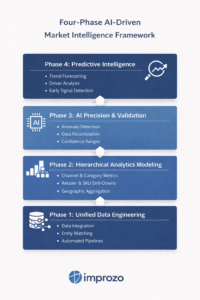
Phase 1 – Data integration
Bringing key internal and external sources into a unified analytics environment.
Phase 2 – Hierarchy structuring
Modeling data across real business dimensions to enable accurate aggregation and rapid drill-down.
Phase 3 – Automation and validation
Reducing manual effort while introducing continuous data quality monitoring.
Phase 4 – Predictive intelligence
Deploying forecasting models, trend detection, and driver analysis.
Importantly, many teams begin seeing meaningful value as early as Phase 2, with predictive capabilities layered in as trust and maturity grow.
Q7: Animal health is an interesting area. Looking ahead, how do you see the role of market intelligence evolving in areas such as animal health?
Jane: Market intelligence in animal health is evolving in ways that mirror broader life sciences through three fundamental shifts:
From retrospective reporting to real-time awareness
Teams will no longer wait for monthly or quarterly summaries. Performance will be continuously visible across channels, geographies, and product hierarchies as market dynamics unfold.
From descriptive metrics to predictive foresight
Analytics will move beyond explaining what happened to forecasting what’s likely to happen next, incorporating seasonality, channel migration, promotions, and competitive behavior with clear assumptions and confidence ranges.
From passive insights to decision enablement
Platforms will not only surface trends, but clearly explain the drivers behind them, supporting faster, more confident commercial decisions.
I’ve seen this shift firsthand in large-scale life sciences organizations. Moving from static reporting to integrated, predictive intelligence fundamentally changes how teams plan, prioritize, and execute. Organizations that make this transition consistently outperform those that don’t.
Final Perspective from Jane
“After working across multiple life sciences organizations, it’s clear that static reports can’t keep pace with today’s market complexity. The future belongs to AI-driven, precision market intelligence platforms that turn fragmented data into timely, predictive insight leaders can actually act on.”
At Improzo, I focus on helping life sciences organizations modernize how they integrate data, structure analytics, and apply AI across complex commercial ecosystems. The goal isn’t more reporting—it’s building scalable, predictive platforms that reduce lag, improve confidence, and enable better decisions at the speed the market now demands.
Author