

What If Every Patient Had an AI Advocate?
A Commercial Life Sciences View on Intelligent Engagement
“Voice will become the most natural interface for healthcare engagement — not because it is novel, but because it removes friction from complex systems. When intelligence meets everyday conversation, execution finally scales.” — Inderpreet Kambo, Cofounder & CEO, Improzo
Life sciences organizations have invested heavily in modern data foundations and engagement infrastructures. Snowflake-powered platforms now aggregate patient, provider, and real-world data at scale. CRM systems orchestrate field activity and omnichannel touchpoints. Advanced analytics surface patterns, segments, and adoption barriers with increasing sophistication.
Yet despite this progress, a familiar challenge persists, translating insight into consistent, real-time execution that meaningfully improves patient and provider journeys. In many organizations, CRM still functions primarily as a system of record, while analytics remains a retrospective layer. Insights are generated centrally and reviewed periodically but often sit outside the flow of daily work. This creates fragmented engagement, delayed responses, and inconsistent experiences across channels. As therapies become more complex and patient expectations continue to rise, insight alone is no longer enough. The real differentiator is how effectively organizations operate intelligence in real time.
The emerging concept of an AI advocate represents a shift from insight production to intelligent orchestration embedded directly into engagement workflows.
Moving from Insight to Intelligent, Voice-Enabled Engagement
Rather than producing periodic recommendations or static next-best-action reports, the AI advocate model leverages agentic AI to continuously monitor real-time data across Snowflake, CRM platforms, digital channels, and patient services. Intelligent agents interpret context, identify emerging barriers, and orchestrate actions automatically as journeys unfold.
Voice-enabled interfaces further remove friction from engagement. Patients, support teams, and field representatives can interact naturally with systems that understand context and trigger workflows instantly. This transforms engagement into a responsive ecosystem — one that adapts as patient needs change, rather than reacting after issues surface.
In practice, AI advocates enable commercial operators to:
- Orchestrate real-time next-best actions across channels, triggering personalized outreach, education, and support workflows as patient and provider signals evolve.
- Embed compliance and data quality directly into execution, using validation agents to ensure interactions meet regulatory standards while strengthening downstream analytics.
- Unify fragmented touchpoints into a continuous journey view, connecting CRM activity, patient services, digital engagement, and real-world data in real time.
- Scale personalization without operational complexity, delivering millions of individualized experiences consistently through automated, intelligent workflows.
Connecting Commercial Execution and Patient Journeys
Engagement in life sciences spans commercial teams, medical affairs, patient services, and digital platforms — often operating in parallel with limited coordination. This fragmentation leads to handoffs, delays, and inconsistent experiences for both patients and providers.
Agentic AI advocates act as an orchestration layer across this ecosystem. By maintaining a longitudinal, real-time view of each journey, intelligent agents align actions across functions and systems. Rather than relying on static reports or manual coordination, orchestration happens dynamically as events occur.
This enables organizations to focus on addressing real barriers — whether access challenges, therapy management complexity, or engagement gaps — while analytics continuously optimize strategies in real time.
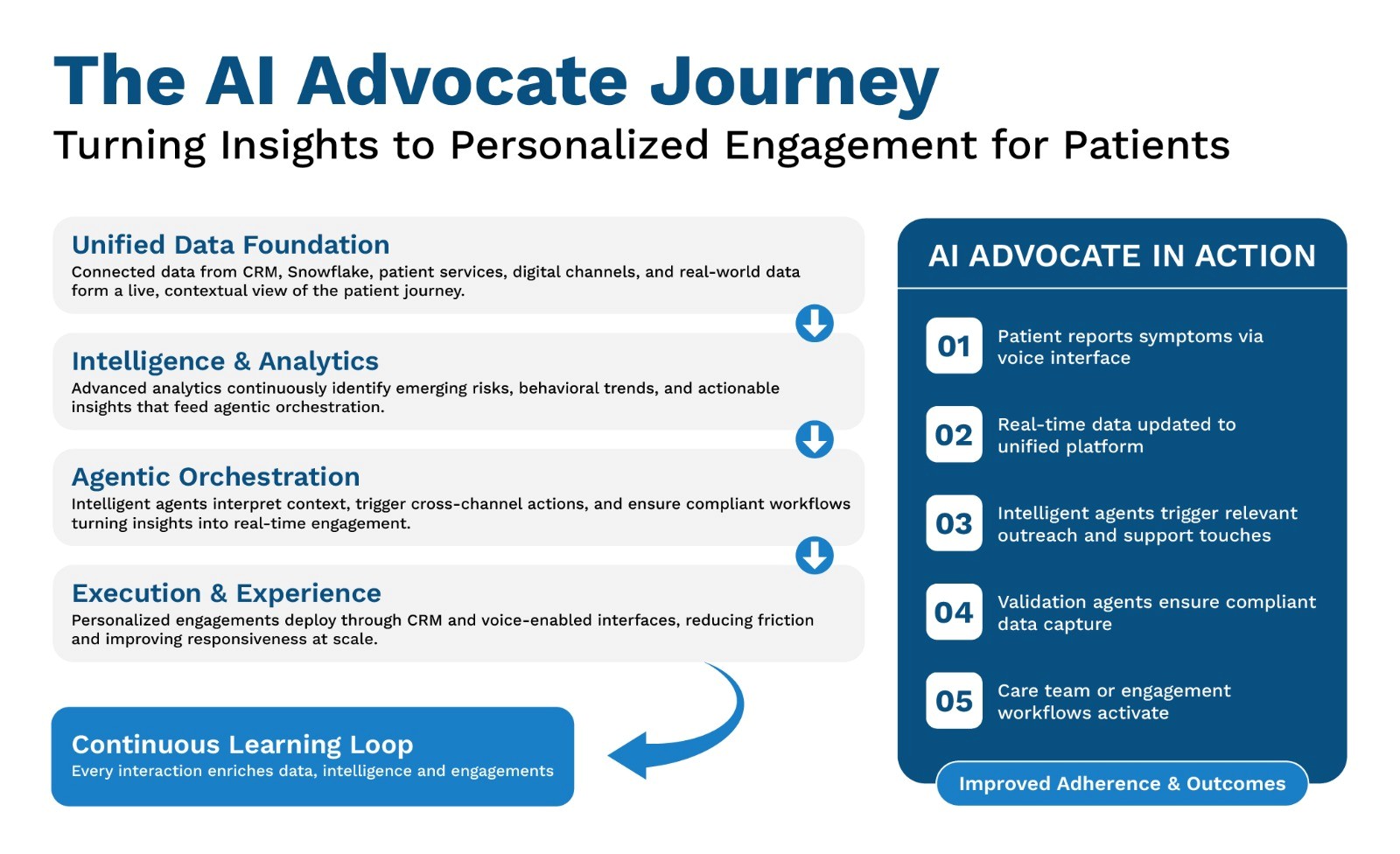
The framework visually illustrates how unified data feeds intelligence, how agentic orchestration connects insight to execution, and how CRM and voice-enabled engagement deliver real-time experiences — all reinforced through continuous learning. For operators, the outcome is faster response, clearer accountability, and measurably improved engagement effectiveness across the lifecycle.
The Improzo Perspective: From Insight to Real-Time Action
At Improzo, we believe the next phase of commercial transformation is not about adding more tools or generating more insights. It is about turning existing platforms — Snowflake, CRM, analytics, into systems of real-time action.
- Agentic AI becomes the connective layer between intelligence and execution. Engagement agents drive personalized actions across channels. Validation agents ensure trust, compliance, and data integrity. Orchestration agents coordinate workflows across commercial, medical, and patient services.
- Voice-enabled engagement removes friction at the experience layer, making interaction more natural while capturing richer context in real time.
Together, these capabilities close the long-standing gap between analytics and execution. For patients, this creates seamless, proactive, and personalized journeys. For commercial leaders, it delivers measurable improvements in efficiency, engagement performance, and outcomes. The next era of life sciences engagement will not be defined by better insights alone, but by how effectively organizations operate in real time, for every journey.
Author